- Mobile Game Development Handbook | A Design Checklist from Concept to Retention and Monetization — For Indie Developers to AAA Studios
- Toroneko’s Three-Motivation Framework
- Game Development Means Designing the Three Types of Motivation
- Design Areas Commonly Required for Live-Service Games
- Design Areas to Review by Development Phase
- Important Points When Reviewing the Design Checklist
- The Correct Design Depends on the Genre
- Live-Service Mobile Games Must Be Designed With Post-Launch Updates in Mind
- Conclusion
Mobile Game Development Handbook | A Design Checklist from Concept to Retention and Monetization — For Indie Developers to AAA Studios

Hello, I’m Toroneko.
One thing I have felt throughout my many years of working in the game industry is that game development is highly dependent on individuals and heavily influenced by the experience and skills of the people creating the game.
At the same time, the core elements of game development can be visualized and systematized. However, much of this knowledge remains inside individual people’s heads instead of being organized and shared.
This creates problems such as:
- Inconsistent game-development quality between game companies
- Differences in quality between departments within the same company
- Missing design elements and inconsistent quality during development
Even major game companies face these problems.
The situation is even more difficult for small game companies and solo developers, who often have to develop games through trial and error.
This is extremely inefficient and a waste of valuable knowledge.
I therefore decided to create something that could serve as a game development handbook for live-service games such as mobile games and online PC games.
After users install and begin playing a live-service game, the team must continue providing events, gacha, new characters, additional progression systems, campaigns, updates, and customer support while creating reasons for players to remain engaged over the long term.
I break this structure down into what I call the following three types of motivation:
- A reason to install the game: Motivation to Install
- A reason to continue playing: Motivation to Keep Playing
- A reason to spend money: Motivation to Spend
Using these three motivations as the foundation, this article explains game-development methods and design areas that developers and producers can apply across different game genres.
This handbook can be used to create the foundation of a game design.
You can then add the elements required for the specific genre you are developing, whether it is an RPG, puzzle game, idle game, card game, simulation game, rhythm game, or location-based game.
Toroneko’s Three-Motivation Framework
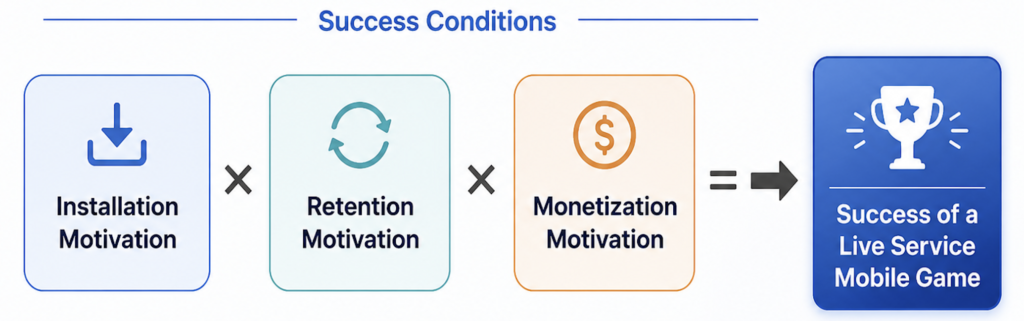
The following three types of motivation are important for live-service mobile games.
Success Formula for Live-Service Mobile Games
Motivation to Install × Motivation to Keep Playing × Motivation to Spend
A game business will not succeed unless all three are established.
Even if one works well, the game will fail if the other two are weak.
| Motivation | Role | Main Related Areas |
|---|---|---|
| Motivation to Install | The reason a player wants to start the game | Concept, IP, worldbuilding, characters, advertising, app store presence, and buzz |
| Motivation to Keep Playing | The reason a player wants to continue playing from the following day onward | Core gameplay experience, progression, rewards, events, community, and short-, medium-, and long-term goals |
| Motivation to Spend | The reason a player wants to pay money | Gacha, passes, packs, characters, time-saving benefits, limited availability, and the desire to own |
To summarize:
- If the Motivation to Install is weak, the game cannot acquire users
- If the Motivation to Keep Playing is weak, users will churn on the first day or within the first few days
- If the Motivation to Spend is weak, the game will not generate revenue
Live-service game development therefore requires teams to design the reason to start, the reason to continue, and the reason to spend as one connected system.
This is the central point of this handbook.
Game Development Means Designing the Three Types of Motivation
Games contain many different elements, including combat, progression, rewards, UI, events, gacha, stories, and characters.
However, developing each element independently will not produce a successful game.
Teams need to understand which of the three motivations each element supports.
| Development Element | Main Related Motivations | What to Review |
|---|---|---|
| Worldbuilding | Install and keep playing | Can it attract interest at first sight, and is it a world players will want to remain involved with? |
| Characters | Install, keep playing, and spend | Is their appeal created through appearance, performance, story, or the desire to own them? |
| Combat | Keep playing | Is the central activity that players repeat enjoyable? |
| Progression | Keep playing and spend | Can players feel themselves becoming stronger, and do they have a reason to continue progressing? |
| Rewards | Keep playing and spend | Do the results of playing provide satisfying rewards? |
| Gacha | Spend and keep playing | Are there desirable rewards, and do those rewards have a purpose after acquisition? |
| Events | Keep playing, spend, and return | Do events create a reason to play during the event period and an opportunity to return? |
| Store Images and Videos | Install | Can they communicate the reason to start within a few seconds? |
| Tutorial | Keep playing | Can players understand the game and experience its appeal? |
| UI/UX | Keep playing and spend | Is friction minimized when controlling the game, progressing, purchasing, and claiming rewards? |
| Community | Keep playing and spend | Does interaction with other users create a reason to continue? |
| Rankings | Keep playing and spend | Is there a reason to compete and aim higher? |
| Passes and Monthly Products | Keep playing and spend | Are continued play and spending connected naturally? |
During development, teams need to confirm:
- What player behavior each feature is intended to generate
- Which motivation the feature supports
Focusing on these questions can significantly improve the quality of game planning, design, and development.
The following sections explain what needs to be designed within each of the three motivations.
Including these elements in planning, design, and development without major omissions creates a foundation for reducing the risk of failure.
Design Areas for the Motivation to Install
The Motivation to Install is the reason a user wants to start the game.
It is strongly influenced by the game’s concept and visual presentation.
The following areas affect whether the game can make users think, “I want to play this.”
| Design Area | What to Review |
|---|---|
| Game Concept | Can the game’s appeal be communicated in one sentence? Can users immediately understand what kind of game it is? |
| Genre | Does the actual experience match what users expect from the genre? |
| Target Audience | Is it clear who the game is for, including age, gender, preferences, and expected play time? |
| IP and Subject Matter | Can the game reach existing fans while also acquiring new users? |
| Worldbuilding | Does the setting, visual presentation, or atmosphere attract interest at first sight? |
| Characters | Is there something about the characters that immediately attracts attention? Is the game designed so players can find a favorite character? |
| Art | Is the artwork appealing enough to stop users when they see it in an advertisement or store listing? |
| Gameplay Screens | Can users understand what they will actually do in the game? |
| Store Images | Do they reduce concerns before installation and create a reason to start? |
| Store Video | Can it communicate controls, pacing, rewards, and character appeal within a short time? |
| Advertising Message | Is there an angle that will generate a response from users seeing the game for the first time? |
| Pre-Registration Message | Is there a reason to register and a reason to claim the rewards? |
| Reviews and Ratings | Do they reduce concerns before users begin playing? |
| App Size and Device Requirements | Have potential concerns before installation been reduced? |
| Game Title and Icon | Can the game be recognized among competing titles and attract attention? |
The game’s appeal must first be visible and understandable.
The team then needs external marketing initiatives that can communicate that appeal effectively.
A game whose appeal and enjoyment cannot be understood until after playing will struggle to create Motivation to Install, making user acquisition more difficult.
The appeal that can be understood before starting the game therefore needs to be designed during development.
Design Areas for the Motivation to Keep Playing
The Motivation to Keep Playing is the reason users want to continue playing the next day, the day after that, and beyond after installing the game.
If this motivation is weak, users will not remain in a live-service game.
The following design areas affect the Motivation to Keep Playing.
| Design Area | What to Review |
|---|---|
| Core Gameplay Experience | What activity will users repeat? Is the center of the gameplay clear? |
| First Session | Can users understand the objective and reach the game’s appeal within the first few minutes? |
| Tutorial | Can users understand the game through play without being overwhelmed by explanations? |
| Early-Game Progression | Can users experience growth, rewards, and a sense of achievement on the first day? |
| Combat, Action, Puzzle, or Other Core Gameplay | Does the central gameplay feel satisfying? |
| Player-Character Progression | Can users feel that their characters have become stronger? |
| Rewards | Can users understand and appreciate the value of the rewards? |
| Daily Content | Is there a reason to play every day? |
| Weekly Content | Is there a reason to return each week? |
| Events | Is there a reason to play during the event period? |
| Login Bonuses | Do they create a reason to log in and play? |
| Missions | Do users know what to do next, and do the missions create a reason to play? |
| Story | Does the story create a reason to continue playing to see what happens next? |
| Character Progression | Is there a reason to continue developing favorite characters? |
| Guilds and Cooperative Features | Is there a reason to continue playing with other users? |
| Rankings and PvP | Is there a reason to compete and aim higher? |
| Collection | Is there a reason to collect items or complete a collection? |
| Long-Term Goals | Is there something to pursue over several weeks or months? |
The Motivation to Keep Playing is created through the core gameplay experience and the play cycle.
Some games attempt to create this motivation primarily through reward distribution.
This may improve visible KPIs in the short term, but it becomes increasingly difficult to sustain over the long term.
Reward distribution alone does not address the core issue.
The reason to continue playing is created through a combination of the gameplay itself, progression, characters, events, community, and long-term goals.
Design Areas for the Motivation to Spend
The Motivation to Spend is the reason users want to pay money.
Live-service games need to create the following within the game design:
- A reason to want something
- A reason to feel that something is lacking
- A reason to purchase now
Attractive products and attractive sales presentation alone cannot create genuine Motivation to Spend.
The following design areas affect the Motivation to Spend.
| Design Area | What to Review |
|---|---|
| Role of Monetized Products | Is it clear what users are expected to spend money on? |
| Gacha | Are there desirable characters, equipment, or items? |
| Character Value | Is value created through performance, appearance, story, or the desire to own the character? |
| Equipment Value | Is there a reason to obtain and improve equipment? |
| Skins and Costumes | Is there a reason to spend money on appearance? |
| Pass Products | Are continued play and spending connected? |
| Monthly Products | Is there a reason to purchase them every month? |
| Starter Packs | Are they attractive enough to purchase during the early game? |
| Limited-Time Products | Is there a reason to purchase now? |
| Sales and Campaigns | Does the offer feel worth more than its price? |
| Pity and Exchange Systems | Do they reduce concerns about spending? |
| Free-to-Play Rewards | Is there a meaningful range of content that can be played without spending? |
| Monetization Pressure | Does the sales approach create frustration or churn? |
| Price Tiers | Do low-, medium-, and high-priced products each have a clear role? |
| Purchase Flow | Can users make a purchase at the moment they want the item? |
Effective monetization design requires the following three elements:
- A reason for users to want the item
- A reason for users to think, “I would be willing to buy it now”
- A reason for users to feel that purchasing it will make the game more enjoyable
Design Areas Commonly Required for Live-Service Games

The previous sections explained design areas based on the three types of player motivation.
The following sections cover the fundamental design areas required for game development.
The necessary features, patterns of play, and reasons to spend differ between RPGs, puzzle games, idle games, card games, simulation games, rhythm games, and location-based games.
However, despite these genre differences, many foundational elements are shared across live-service games.
Use the following areas as a checklist to prevent important omissions during game design and development.
Game Concept Design
| Design Area | What to Review |
|---|---|
| One-Sentence Game Description | Can someone immediately understand what kind of game it is? |
| Primary Appeal | Is there a reason to choose this game? |
| Target Audience | Is it clear who should play the game? |
| Play Context | Is it clear when, where, and for how long users are expected to play? |
| Competitive Difference | Can the difference from existing titles be explained? |
| Reason to Continue | Can the team explain why users will continue playing? |
| Reason to Spend | Can the team explain why users will pay money? |
| Development Scope | Can the game be completed with the planned team size and development period? |
| Live-Operations Scope | Can the team continue providing updates after launch? |
Core Gameplay Experience Design
| Design Area | What to Review |
|---|---|
| Core Activity | What action will users repeat? |
| Controls | Can the game be played comfortably on a smartphone? |
| Decision-Making | Does the core gameplay give users opportunities to think and make decisions? |
| Success Experience | Does success feel satisfying? |
| Failure Experience | Does failure make users want to try again? |
| Pacing | Can the game be played in short sessions without unnecessary frustration? |
| Presentation | Does the presentation make gameplay results feel satisfying and exciting? |
| Replayability | Is there a reason to repeat the same activity? |
| Sense of Progression | Can users feel a difference before and after playing? |
First-Time User Experience Design
| Design Area | What to Review |
|---|---|
| First Launch | Will users churn because of waiting times or loading immediately after launch? |
| Initial Introduction | Are the world, objective, and required actions communicated? |
| Tutorial | Is it short enough while still explaining the game’s appeal and systems? |
| First Battle or First Play Session | Can users experience the game’s appeal during their first session? |
| First Reward | Can users understand the benefit and value of the reward? |
| First Progression Experience | Can users feel that they have become stronger? |
| First Gacha | Does it create anticipation for characters or items? |
| First-Day Goal | Do users know what they should accomplish on the first day? |
| Early Churn Points | Has the team identified where users leave and prepared countermeasures? |
Play-Cycle Design
| Design Area | What to Review |
|---|---|
| Login | Is there a reason to launch the game? |
| Play | Is the gameplay flow easy to understand, and does it create a desire to play again? |
| Reward Acquisition | Do users receive rewards for playing, and are the rewards appropriate? |
| Progression | Is it clear where rewards should be used? Does progression feel satisfying? |
| Replay | Is there a reason to play again? |
| Goal Renewal | Are new goals continually provided? |
| Return Login | Is there a reason to launch the game again on the following day and beyond? |
| Long-Term Progression | Is there a reason to play for several days or weeks? |
Progression-System Design
| Design Area | What to Review |
|---|---|
| Progression Targets | Is it clear whether users are developing characters, equipment, facilities, skills, or other elements? |
| Progression Materials | Is it clear what users need to collect? |
| Progression Stages | Are there stages such as levels, evolution, awakening, or limit breaking? |
| Progression Impact | Can users feel that they have become stronger? |
| Progression Cost | Are the required materials and currency amounts appropriate? |
| Progression Priorities | Can users determine what they should develop first? |
| Long-Term Progression | Are there progression goals lasting several weeks or months? |
| Progression Blockers | Does the team understand what may prevent users from progressing? |
| New-User Support | Can users who start later catch up? |
Reward Design
| Design Area | What to Review |
|---|---|
| First-Time Rewards | Do rewards received immediately after playing feel valuable? |
| Standard Rewards | Is there a reward for each play session? |
| Daily Rewards | Are daily rewards available, and do they have value? |
| Weekly Rewards | Are weekly rewards available, and do they have value? |
| Event Rewards | Are the rewards valuable enough to motivate participation? |
| Ranking Rewards | Are the rewards valuable enough to motivate competition? |
| Gacha Rewards | Does the reward pool contain desirable items? |
| Material Rewards | Are they connected to progression? |
| Free-to-Play Rewards | Is there a reason for non-paying users to continue playing for rewards? |
| Payer Rewards | Does spending provide value that users can accept? |
| Surplus Rewards | Is there a use for excess materials and items? |
Game-Economy Design
| Design Area | What to Review |
|---|---|
| Free Currency | Are acquisition volume and usage destinations designed appropriately? |
| Paid Currency | Is there a reason to purchase it and a place to spend it? |
| Progression Materials | Are acquisition and required quantities balanced? |
| Resource Sinks | Are there places to spend currency and materials? |
| Supply Volume | Is excessive distribution reducing value? Is the economy balanced? |
| Scarcity | Does scarcity support player goals without creating excessive frustration or stress? |
| Exchange Shop | Is there a use for excess materials? |
| Inflation Control | Can the in-game economy remain functional during long-term operation? |
| Paid-Currency Design | Are the differences and benefits of paid and free currency understandable? |
| Late-Starting Users | Has the burden on users who start later been reduced? |
Character and Item Design
| Design Area | What to Review |
|---|---|
| Character Role | Does each character have gameplay value, story value, visual appeal, and a clear role? |
| Rarity | Does rarity feel meaningful and justified? |
| Performance Differences | Are differences in strength easy to understand? |
| Attributes and Matchups | Do they affect team composition and strategy, and are they balanced? |
| Collectability | Is there a reason to collect the characters or items? |
| Favorite-Character Appeal | Is there a reason for users to become attached to them? |
| Ongoing Additions | Can the team continue adding new characters and equipment? |
| Protection of Existing Assets | Will older characters avoid suddenly losing all value? |
| Rerun Value | Is there a reason to bring back previous characters and items? |
Gacha and Sales Design
| Design Area | What to Review |
|---|---|
| Gacha Contents | Is it clear what users are pulling for? |
| Reward Pool | Does it include desirable rewards? |
| Rates | Is the design acceptable to users? |
| Pity System | Does it provide reassurance and acceptable value relative to the amount spent? |
| Exchange System | Is there a system that allows users to move closer to obtaining the desired reward? |
| Limited Availability | Is there a reason to pull now? |
| Reruns | Can previous assets be reused? |
| First-Purchase Discount | Does it create a reason to make the first purchase? |
| Packs | Can users purchase products based on specific objectives? |
| Passes | Are continued play and spending connected? |
| Monthly Products | Is there a reason to purchase them every month? |
| High-Priced Products | Do products for high-spending users provide acceptable value? |
| Sales Frequency | Are too many offers creating frustration? |
Event Design
| Design Area | What to Review |
|---|---|
| Event Objective | Is the event intended to improve retention, reactivation, spending, or visibility? |
| Duration | Is the event neither too long nor too short? |
| Participation Requirements | Can new users participate? |
| Rewards | Is there a reason to participate? |
| Difficulty | Can a broad range of users play the event? |
| Repeatable Content | Is there a reason to replay it? |
| Rankings | Is there a reason to compete? |
| Story | Does the event offer a story with its own appeal? |
| Gacha Integration | Are the reasons to obtain items and play the event connected? |
| Rerun Operations | Is the event structured so it can be reused? |
| Event Announcement | Can the reason to participate be communicated before the event begins, and is it being communicated? |
UI/UX Design
| Design Area | What to Review |
|---|---|
| Home Screen | Can users quickly access important information? |
| Menus | Can users reach the feature they need? |
| Progression Screen | Are upgrade effects and required materials clear? |
| Team-Building Screen | Can users select characters and equipment easily? |
| Battle Screen | Are the current situation and controls understandable? |
| Reward Screen | Is it clear what the user obtained? |
| Shop Screen | Is it clear what users should purchase, and is the product appeal communicated? |
| Gacha Screen | Can users review the reward pool, rates, and pity system? |
| Event Screen | Are participation requirements, rewards, and time remaining clear? |
| Notifications | Can information be delivered at the necessary time? |
| Claim Flow | Can users easily claim rewards, mission rewards, and gifts without overlooking them? |
| Purchase Flow | Can users proceed easily to purchase when they want an item? |
Live-Operations Design
| Design Area | What to Review |
|---|---|
| Update Frequency | How often will new elements be added? |
| Event Cadence | Is there a monthly and weekly operating cycle? |
| Gacha Cadence | Is there a cycle for new, rerun, and limited gacha? |
| Content Additions | Can new forms of gameplay be added? |
| Announcements | Can information be delivered to users appropriately? |
| Bug Response | Is there a structure for responding quickly? |
| Customer Support | Can the team respond to user inquiries? |
| Update Plan | Are short-, medium-, and long-term updates planned? |
| Operational Workload | Can the team sustain the required workload? |
| Asset Production | Can the team continue producing characters, events, banners, and announcements? |
| Rerun Plan | Can previous events and products be reused? |
| New-User Initiatives | Can the team support the retention of users who start later? |
| Reactivation Initiatives | Is there a reason for churned users to return? |
KPI and Tracking Design
| Design Area | What to Review |
|---|---|
| Installs | Can the number of acquired users be measured? |
| First Launch | Can the number of users who launch the game after installation be measured? |
| Tutorial Completion | Can the team identify where users leave? |
| D1 Retention | Can the team confirm whether users return the day after starting? |
| D3 and D7 Retention | Can the team confirm whether users remain during the early game? |
| D30 Retention | Can the team confirm whether users remain during the medium term? |
| Payer Conversion | Can spending behavior be measured? |
| ARPU | Can revenue relative to DAU be measured? |
| ARPPU | Can average spending per paying user be measured? |
| LTV | Can lifetime spending over a defined period be measured? |
| Event Participation Rate | Can the team confirm whether users are playing the event? |
| Gacha Usage Rate | Can the team confirm whether users are engaging with the gacha? |
| Shop Purchase Rate | Can the team confirm whether products are being purchased? |
| Churn Points | Can the team identify where users leave? |
| Reviews | Can the team monitor dissatisfaction and user evaluations? |
| Purchase Flow | Can the team identify which screens lead to purchases? |
| Reward Claims | Can the team confirm whether rewards are being claimed? |
Design Areas to Review by Development Phase

The areas that need to be reviewed differ between planning, prototype development, full production, alpha and beta builds, CBT and OBT, and post-launch operations.
Reviewing both the design and the state of development during each phase improves the quality of the final game.
What to Review During the Planning Stage
| Review Area | What to Review |
|---|---|
| Reason to Install | Can the team explain why users will want to start? |
| Reason to Continue | Can the team explain why users will continue playing? |
| Reason to Spend | Can the team explain why users will pay money? |
| Core Gameplay Experience | Is it clear what activity users will repeat? |
| Target Audience | Is it clear who will play the game? |
| Competitors | Which titles will the game be compared with, and can it compete? |
| Development Scope | Can the planned game be completed? |
| Live-Operations Scope | Can the team continue updating the game? |
| First-Time Experience | Can users understand the game’s appeal immediately after starting? |
What to Review in the Prototype
| Review Area | What to Review |
|---|---|
| Core Gameplay Experience | Can the team confirm through actual play that the game is enjoyable? |
| Controls | Can the game be played comfortably on a smartphone? |
| Pacing | Can it be played without unnecessary frustration? |
| Sense of Achievement | Does playing produce satisfaction and a positive feeling? |
| Sense of Progression | Can users feel that they are becoming stronger? |
| Replay Motivation | Is there a reason to play again? |
| Development Reproducibility | Can the design described in the plan be reproduced in the actual implementation? |
| UI and Controls | Are they understandable and easy to use? |
A prototype does not need to have the same visual quality as the completed game.
The key point is to confirm whether the central gameplay—the core experience—works.
The team should prioritize whether the game is enjoyable when played and whether there is a reason to play repeatedly over graphics and presentation.
What to Review During Full Production, Alpha, and Beta
Confirm whether the planned content has been implemented.
| Review Area | What to Review |
|---|---|
| First-Time Experience | Can users experience the game’s appeal after installing it? |
| Progression Design | Is there a reason to progress? |
| Reward Design | Are gameplay and rewards connected? |
| Monetization Design | Is there a reason to want the products, and is there a purchase flow? |
| Event Design | Have post-launch events been designed? |
| UI/UX | Is the game understandable and easy to use? |
| Tracking Design | Has the required tracking been implemented? |
| Live-Operations Preparation | Are the assets and materials required after launch being prepared? |
| Progression Balance | Can users progress and play without excessive frustration? |
| Economy Balance | Are currency and material values functioning properly? |
| Operational Workload | Can the team sustain the required workload? |
| Development Progress | Has the planned content been implemented? |
Definitions of full production, alpha, and beta differ between game companies.
For this reason, they are grouped together here rather than divided into detailed stages.
These stages sit between the prototype and CBT or OBT.
It is therefore useful to repeat both the prototype review items and the CBT or OBT review items during full production, alpha, and beta.
What to Review During CBT and OBT
| Review Area | What to Review |
|---|---|
| Server Load | Are there problems with concurrent connections or payment processing? |
| First-Time Experience | Can first-time users reach the game’s appeal? |
| Retention | Are there major problems with D1, D3, or D7 retention? |
| Purchase Flow | Can users complete purchases without problems? |
| Bugs | Are there progression blockers or reward-related bugs? |
| Store Messaging | Does the actual game match what is communicated in the store listing? |
| Paid User Acquisition | Are users acquired through advertising churning excessively during the first-time experience? |
| First-Month Operations | Are the events and products for the immediate post-launch period ready? |
| Customer Support | Is there a system for responding to user inquiries? |
The required review areas for CBT and OBT will differ depending on how the team defines the purpose and objectives of each test.
Some teams may also conclude that retention and monetization cannot be validated accurately during CBT or OBT because the testing environment is not identical to the live service.
The team should therefore define the purpose of the CBT or OBT first and then decide what needs to be validated.
What to Review After Launch
| Review Area | What to Review |
|---|---|
| Acquisition | Is the game acquiring new users? |
| Retention | Are users remaining in the game? |
| Churn | Does the team understand where and why users leave? |
| Reactivation | Are there paths and triggers that encourage churned users to return? |
| Monetization | Are users spending money? |
| Investment Recovery | Is there a reasonable path to recovering advertising costs? |
| Health | Are there significant complaints or risks of backlash, and are reviews healthy? |
| Events | Are users participating? |
| Gacha | Is the game providing what users want? |
| Improvement Capability | Does the team have the structure and environment required to address issues? |
| Updates | Are the next events, gacha, and additional features being prepared? |
Important Points When Reviewing the Design Checklist

The previous sections list design areas for each development phase.
When presented as a checklist, it may appear that the objective is to include every possible feature.
However, the important point is not to include every feature.
The important question is which of the following motivations each feature supports:
- Motivation to Install
- Motivation to Keep Playing
- Motivation to Spend
Live-service games function through the multiplication of these three motivations.
A feature whose purpose cannot be explained is not necessarily required.
Even if it is developed, it may not contribute to any of the three motivations.
Developing too many features can also increase development workload, make the UI more complicated, and make the game more difficult for users to understand.
The Correct Design Depends on the Genre
The areas in this handbook are design elements that should be reviewed when developing live-service mobile games.
They are useful for building the underlying structure of a game.
However, they need to be adjusted for each game genre.
The required features, patterns of play, and reasons to spend differ between RPGs, puzzle games, idle games, card games, simulation games, rhythm games, and location-based games.
The design therefore needs to be adjusted according to:
- The game concept
- The genre
- The target audience
- The development scope
- The live-operations structure
Live-Service Mobile Games Must Be Designed With Post-Launch Updates in Mind
A live-service mobile game is not a product that is finished once it launches.
After launch, the team needs to continue providing events, gacha, characters, rewards, campaigns, and updates.
Development therefore needs to include reviews based on the post-launch live-operations phase.
Without this perspective, teams may create games that are difficult to operate and difficult to monetize.
| Review Area | What to Review |
|---|---|
| Updates | Can new elements be added? |
| Additional Characters | Can the team continue releasing new characters? |
| Additional Events | Can the team continue producing events? |
| Reward Design | Can new rewards be added without damaging the game economy? |
| Reruns | Can previous events and products be reused? |
| Operational Workload | Can the team sustain the required workload? |
| New-User Support | Can the burden on users who start later be reduced? |
| Reactivated-User Support | Can the game create a reason for churned users to return? |
A game developed without considering post-launch operations may perform well during the first month but become increasingly difficult to operate afterward.
Common examples include:
- A character sells well, but developing additional characters takes too long
- The content is enjoyable, but the technical or design structure makes additional content difficult to produce
- The design provides limited flexibility for live events, making it difficult to create enough variation
The team needs to connect installation, retention, monetization, and live operations from the development stage.
Conclusion

A live-service mobile game cannot succeed as a business through gameplay quality alone.
Teams need to design:
- A reason for users to start
- A reason for users to continue playing from the following day onward
- A reason for users to want to spend money
Motivation to Install × Motivation to Keep Playing × Motivation to Spend
A live-service mobile game becomes a viable business only when all three are established.
If any one of them is missing, the business will not succeed.
Developers and producers should not design combat, progression, rewards, UI, events, gacha, live operations, and KPIs as isolated elements.
They should confirm which motivation each element supports while designing the game.
The objective is not to add features without a clear reason.
The objective is to create reasons for users to want to play the game, continue playing, spend money, and remain engaged after launch.
That is the foundation of live-service mobile game development and the central message of this handbook.
Please contact me if you need support with game design.