
- Mobile Game Live Operations Manual | How to Improve Retention, DAU, Conversion, and Revenue
- Live-Title Improvement Manual
- [Goal] Setting Objectives for a Live-Title Improvement Initiative
- [Current-State Assessment] Identifying the Issues Affecting the Title
- [Feasibility] What Can and Cannot Be Addressed
- [Schedule] Building the Roadmap for Improvement
- Breaking Down DAU Divides the Improvement Targets into Three Groups
- Individual Developers, Indie Developers, and Small and Medium-Sized Companies Also Have Room to Improve
- How Toroneko Supports Live-Title Improvement
- Appendix: Initial Checklist for Improving a Live Title
- 1. Confirm the Goal: What Will Define Success?
- 2. Assess the Current State: Determine the Title’s Current Position
- 3. Confirm the Issues: Which of the Three Types of Motivation Has a Problem?
- 4. Confirm the KPIs: Metrics That Should Be Reviewed
- 5. Review Information Beyond the KPIs: Are Decisions Being Based Only on Numbers?
- 6. Decide Whether to Focus Primarily on New, Retained, or Reactivated Users
- 7. Confirm Feasibility: Separate What Can and Cannot Be Addressed
- 8. Confirm the Schedule: Decide What Will Be Done and When
- 9. Final Review: Has the Number of Initiatives Become Too Large?
- Checklist Summary
- Conclusion: Improving a Live Title Is Not About Fixing Everything, but Deciding What to Fix First
Mobile Game Live Operations Manual | How to Improve Retention, DAU, Conversion, and Revenue

Hello, I’m Toroneko.
This time, I have created a practical manual for improving the KPIs of mobile games already in live operation—an area I am frequently asked to advise on.
In general, improving an existing mobile game requires teams to examine the following:
・Identify where retention and DAU are declining and where payer conversion is falling
・Determine the causes and address them
However, the same approach will not work for every game.
The ability to acquire new users and reactivate churned users differs between a title that launched six months to one year ago, one that has been in operation for three to five years, and one that has been running for more than ten years.
The player profiles of casual games also differ from those of games designed for core players.
In other words, every game is in a different condition.
For this reason, the following four points must be defined before beginning an improvement initiative for a live title:
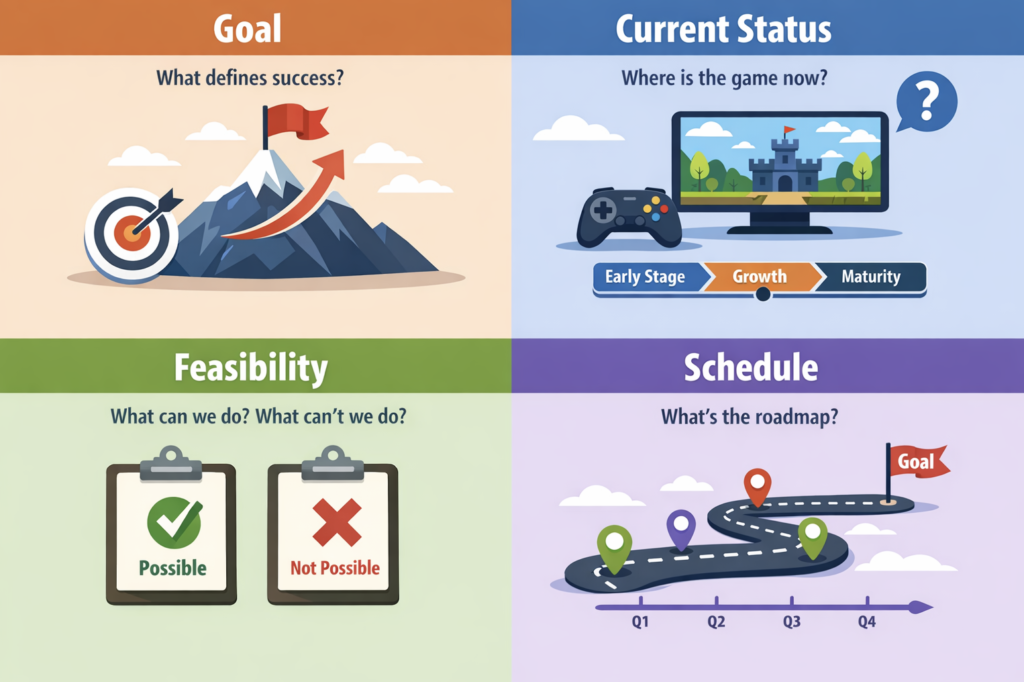
[Goal] What outcome will define success?
[Current-State Assessment] What is the game’s current condition and lifecycle stage—or product phase?
[Feasibility] What can and cannot be addressed internally?
[Schedule] What roadmap and timeline will be used to implement the improvements?
The key point is that time, budget, development capacity, and other practical resource constraints make it difficult to address every issue.
A live-title improvement initiative therefore needs a clear definition of what will be addressed within these four areas.
If these points remain unclear, the improvement initiative will not succeed.
This article explains the areas to review when improving an existing mobile game, how to set priorities, how to build a roadmap, and concludes with a checklist that can be used immediately.
I hope it will be useful when reviewing the games you operate.
Why Improving Live Titles Matters in the Game Business

Increasing revenue from existing titles is critical to maintaining a stable game business.
This is because developing a new game requires significant time and investment, while the barrier to achieving commercial success is also high.
The financial impact can be substantial when a game fails to become a hit.
However, game companies cannot avoid developing new games if they want to survive.
Existing titles, by contrast, already have users and generate revenue.
They therefore play a major role in funding game development and stabilizing the overall game business.
For game companies, maintaining existing titles while building a sustainable revenue base from them is an important business challenge.
From here, I will organize the areas that should be reviewed when improving an existing title in the following order: goal, current-state assessment, feasibility, and schedule.
Use this process to design your improvement plan.
Live-Title Improvement Manual
[Goal] Setting Objectives for a Live-Title Improvement Initiative
- Improve retention
- Recover DAU
- Improve payer conversion
- Recover revenue
- Increase new-user acquisition
- Increase the number of reactivated users
- Improve profitability without changing the number of retained users
- Do not pursue every objective at the same time
When there are too many objectives, priorities begin to break down.
The KPIs that need to be monitored and the initiatives that need to be implemented will also differ, so the objectives must first be aligned internally.
Attempting to address everything is particularly likely to cause a live-title improvement initiative to fail.
The team should decide whether the priority is DAU recovery, revenue improvement, or profit improvement, and begin by addressing the area most directly connected to that objective.
[Current-State Assessment] Identifying the Issues Affecting the Title
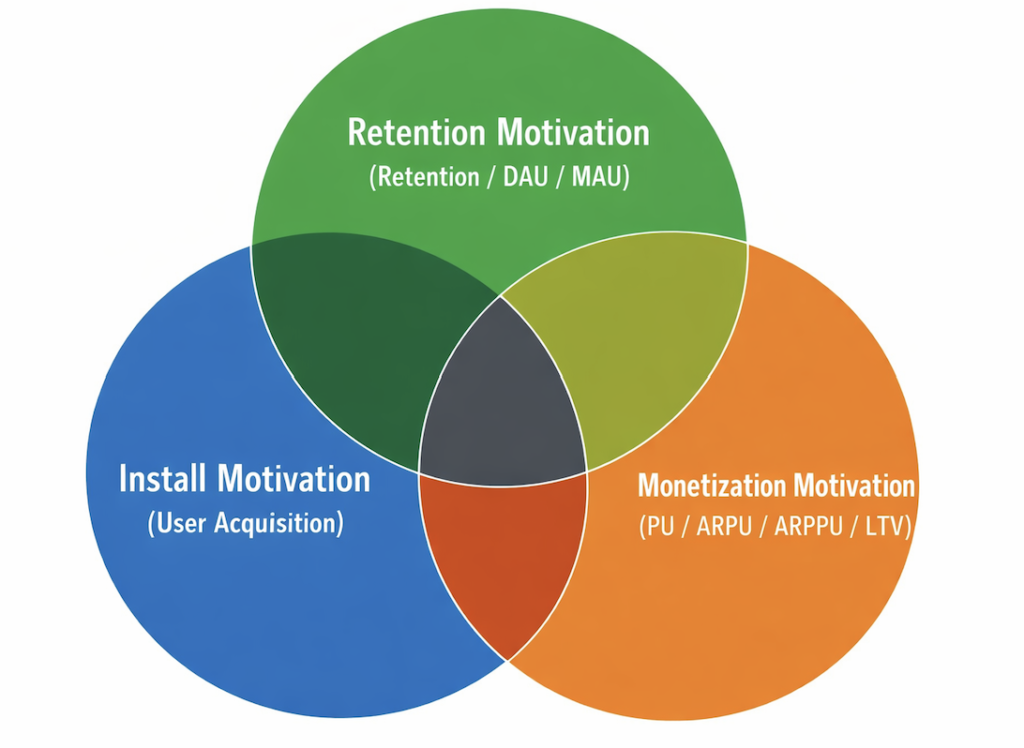
First, identify all of the issues affecting the existing game.
Live-service games such as mobile games are built on the interaction of the following three types of player motivation:
1. Motivation to Install: user acquisition
×
2. Motivation to Keep Playing: retention, DAU, and MAU
×
3.Motivation to Spend: PU, ARPU, ARPPU, and LTV
For many live-service mobile games, growth is likely to stall when there is a major problem in any one of these three areas.
The objective is therefore to identify the issues hidden within these three areas.
1. Motivation to Install
Motivation to Install covers the following process:
“Become aware that the game exists → become interested in it → install it → launch it and be counted as one user.”
Identify the issues that interfere with this process.
For example, issues may exist in the following areas:
- Insufficient awareness of the game
- Insufficient understanding of the game
- Incorrect promotional messaging
- Insufficient ASO
- A lack of game appeal that can be understood visually
- No compelling reason to install the game
- Barriers that prevent users from installing the game
Potential barriers range from marketing issues to problems with the game itself.
The specific issues will differ by title, but these perspectives can be applied broadly.
2. Motivation to Keep Playing
Motivation to Keep Playing refers to a player’s desire to continue playing the game.
It tends to be reflected in retention and DAU and is a critical factor in the game business.
Identify the issues that reduce this motivation.
For example, issues may exist in the following areas.
Early-Stage Issues
- The controls are difficult to use
- The UI is difficult to understand
- The game performs poorly
- The rules are difficult to understand
- Players do not know what they should do
- Players do not know what they should do next
- Players lose one-sidedly
- Players do not understand how to progress
- The game is different from what players expected
Early-stage issues are factors that reduce the Motivation to Keep Playing before users are able to begin enjoying the game.
Many of these issues relate to the game itself, although pre-installation promotion can also contribute to some of them.
Mid-Stage Issues
- Players cannot win or clear content
- Players cannot win or clear content regardless of how many times they try
- Players do not feel a sense of progression
- The game is not enjoyable
- Players cannot see where they are heading or what the goal is
- Players cannot find a reason to continue playing tomorrow, the day after tomorrow, or next week
Mid-stage issues are factors that reduce the Motivation to Keep Playing once users have reached the stage where they should be enjoying the game.
Most of these issues relate to the game itself.
Long-Term Issues
- The game has become repetitive and players are becoming bored
- There is nothing left to do
- Players have cleared all available content
- Players are repeating the same activities
- Players cannot find a reason to continue playing in the future
Long-term issues involve a decline in the Motivation to Keep Playing among users who have already played the game for a meaningful period.
These issues can exist not only in the game itself but also in its ongoing live operations.
Viewed over time, the progression is as follows:
Early stage
→ Mid-stage retention period
→ Long-term live-operations phase
The exact progression will differ by game.
The key point is that the issues affecting the Motivation to Keep Playing differ according to how deeply and how long users have played the game.
3. Motivation to Spend
Motivation to Spend refers to:
“A player’s motivation to spend money on the game, which tends to be reflected in KPIs such as PU, ARPU, ARPPU, and LTV.”
This is another critical process in the game business.
Identify the issues that reduce this motivation.
For example, issues may exist in the following areas:
- Players can continue playing without spending: a difficulty-design issue
- Free items are sufficient even when players are willing to spend: an in-game economy issue
- There is nothing players want to purchase: a product-value issue affecting monetized content
- Players do not want to spend: an issue with the appeal of the game itself
- Monetization prompts or spending pressure are too aggressive: a payer-fatigue issue
Potential issues can be found across the core gameplay loop, game balance, monetization systems, and live operations.
Areas to Review
Identify the issues affecting these three types of motivation.
The following methods can be used.
Review the KPIs
- Retention: Day 1, Day 7, Day 30, and so on
- DAU, WAU, and MAU
DAU consists of three types of users.
Instead of looking only at the total, examine the composition of DAU to determine why it is declining.
DAU
└ New users
└ Retained users
└ Reactivated users
- PU, ARPU, ARPPU, and ROI
Review monetization KPIs together with factors such as days played, measurement coverage, and DAU to understand how they relate to one another.
Retention, DAU, payer conversion, and revenue are not separate. They are interconnected.
- When retention declines, DAU declines
- When DAU declines, revenue is also more likely to decline
- Even if payer conversion is improved, revenue will not recover if retention remains weak
These metrics must therefore be examined as connected parts of the same system.
Review Information Beyond the KPIs
KPIs represent the outcomes produced by users who played the game.
However, decisions about improving an existing title should not be based on KPIs alone.
This is because:
- KPIs cannot directly visualize player emotions
- Games are entertainment products designed to move players emotionally
- Players may continue playing reluctantly even when they have complaints or experience significant problems
Overreliance on KPIs prevents teams from reaching the core issues affecting the title.
KPIs should therefore be combined with the following sources of information:
- User surveys
- Internal playtesting
- Playtesting and reviews conducted by external partners
- Closed tests involving current players
- Hypothesis development based on the information collected
User surveys can collect a broad range of potential issues, but they do not necessarily capture players’ true feelings directly.
This is because user surveys:
- Are conducted after the issue has occurred, creating a time gap
- Are completed after respondents have had time to reflect calmly
- Contain biases based on the users who choose to respond
Internal and external playtests do not perfectly reproduce the perspective of the users who actually play the game.
The more professional or game-industry experience a tester has, the more likely their perspective is to contain its own biases.
Depending on the test design, closed tests involving current players can capture the moment an issue occurs and provide deeper insight into its underlying cause.
Finally, hypotheses should be developed from the information collected, allowing the team to narrow down the potential issues.
[Feasibility] What Can and Cannot Be Addressed
Evaluate the identified issues according to feasibility, determining what the company can address and which areas will be difficult to change.
Prioritizing an issue that cannot be addressed under the current organizational structure will not lead to improvement.
The team should therefore select issues that can be resolved within the resources and capabilities available.
The key is to organize them according to time:
- Cannot be addressed
- Can be addressed immediately
- Can be addressed with sufficient time
This classification will affect the next stage: the schedule.
[Schedule] Building the Roadmap for Improvement
Finally, define a schedule for addressing the issues.
The important point is that improving an existing title does not mean every issue must be addressed immediately.
Some issues may be addressed this month, while others may require enough time that they cannot be addressed until one year later.
When immediate improvement is not possible, the current period can be defined as a period for maintaining the title, while a roadmap is created to implement improvements in stages after six months or one year.
If the main improvement initiative can be implemented one year from now, build a manageable roadmap around that assumption.
Breaking Down DAU Divides the Improvement Targets into Three Groups
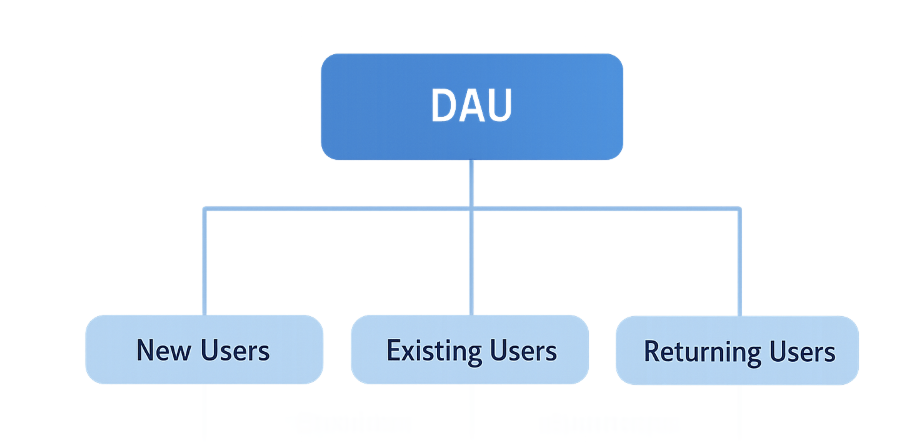
DAU consists of three types of users:
DAU
└ New users
└ Retained users
└ Reactivated users
Understanding these three groups makes it possible to improve an existing title through user acquisition and retention initiatives.
This distinction becomes particularly important when DAU improvement is selected as the primary objective.
New Users
When potential target users still remain in the market, there is room to acquire additional new users.
In other words, the title still has new-user acquisition potential that has not yet been fully captured.
The reasons will differ according to how long the game has been in operation, but may include:
- Problems with promotion
- Potential users who have not yet been identified or reached
- The company has not actively pursued new-user acquisition
There may be various reasons, but if acquisition potential remains, capturing those users can contribute to improving the title.
For long-running titles, however, much of the available market may already have been reached, making it difficult to recover DAU through new-user acquisition alone.
Retained Users
Retained users are the most important group within DAU.
Because these users are already continuing to play the game, simply preventing additional churn can contribute to improving the title.
Retaining current users becomes increasingly important the longer a game has been in operation.
When acquiring new users becomes difficult, reducing churn among retained users becomes the central component of DAU improvement.
Reactivated Users
Reactivated users—users who return after leaving the game for some reason—are also important when improving a title.
The basic premise is that users have a reason for leaving a game.
They can be reactivated by addressing the reason they left and communicating that the issue has been improved.
The longer a game has been in operation and the larger its cumulative install base, the greater the potential pool of churned users who may be reactivated.
However, reactivated users have the following characteristics:
- Users who have churned once are more likely to churn again
- In many games, reactivated users tend to have a lower LTV than new users
For many titles, reactivated users therefore cannot be treated as having the same value as new users.
Because they have already churned once, they are more likely to churn again after returning.
Their spending also tends to be lower than that of new users.
As a result, acquiring the same number of new users and reactivated users does not produce the same revenue impact.
For many titles, reactivation initiatives alone cannot serve as the main driver of revenue recovery.
Individual Developers, Indie Developers, and Small and Medium-Sized Companies Also Have Room to Improve
This framework does not apply only to major game companies.
Individual developers, indie developers, and small and medium-sized companies often do not review ASO, KPIs, and retention thoroughly enough.
For example, reviewing ASO alone may increase the number of users acquired.
Small changes may also produce results when users are churning during the early game, the monetization path is weak, or there is no reactivation path for churned users.
Even when a large-scale update is not possible, the first step should be to identify the issues and address what can be changed.
For small and medium-sized game companies in particular, it is important not to create too many initiatives.
- Narrow down the objective
- Set priorities
- Clearly define what cannot be done
Simply identifying the issues affecting an existing title can reveal what the company is able to address.
In many cases, there is no need to proceed with everything at the same time.
Separate what should be done now, what should be done after six months, and what should be done after one year.
Some areas can be improved simply by addressing them consistently over the long term.
How Toroneko Supports Live-Title Improvement

When improving an existing title, it is important to align the different perspectives and problem awareness within the game company.
The following situations are common:
- The development team is primarily concerned with game development and implementation workload
- The live-operations team focuses only on daily initiatives
- The marketing team focuses only on user acquisition
- The management team focuses only on profit
The company must therefore first define a shared goal.
Next, priorities must be established across areas such as KPI interpretation, identifying churn points, retention, DAU, payer conversion, and revenue.
Short-, medium-, and long-term roadmaps should then be created and aligned internally.
It is also important to assess the title’s product lifecycle stage and determine whether new users can still be acquired or whether retained and reactivated users should be prioritized.
Toroneko helps game companies organize these issues and make decisions based on the specific condition of each title.
Please contact me if you do not know what should be addressed first, if internal opinions are divided, or if you want to determine whether the current title still has room for improvement.
Appendix: Initial Checklist for Improving a Live Title
Finally, I have compiled a checklist of the areas that should be reviewed when improving an existing title.
Begin by using the following checklist to assess the current condition of your game.
1. Confirm the Goal: What Will Define Success?
Select the highest-priority objective for this live-title improvement initiative:
- Improve retention
- Recover DAU
- Improve payer conversion
- Recover revenue
- Increase new-user acquisition
- Increase the number of reactivated users
- Improve profitability without changing the number of retained users
- Prioritize profit improvement
- Prepare for a major improvement initiative or anniversary event in six months or one year
Review Points
- Have the objectives been narrowed down to one or two?
- Does the company share the same definition of success?
- Are priorities aligned across development, live operations, marketing, and management?
- Has the team decided whether this is a short-term improvement initiative or a medium- to long-term turnaround?
2. Assess the Current State: Determine the Title’s Current Position
A. Confirm the Title’s Lifecycle Stage
- Has the game been live for approximately six months to one year?
- Has it been in operation for approximately three to five years?
- Has it been in operation for more than five years?
- Has it been in operation for more than ten years?
Review Points
- Is there still an addressable market from which new users can be acquired?
- Has the title already reached most of its available market?
- How much potential remains to reactivate churned users?
- Has long-term operation caused the experience to become repetitive?
B. Confirm the KPIs That Need Improvement
- At what point is retention declining?
- What is causing DAU to decline?
- Is payer conversion declining?
- What is the primary cause of the revenue decline?
- Has new-user acquisition become more difficult than before?
- Has user reactivation become more difficult than before?
C. Confirm the Composition of DAU
Analyze DAU by dividing it into the following three groups:
- New users
- Retained users
- Reactivated users
Review Points
- Is the number of new users declining?
- Is churn among retained users increasing?
- Have reactivated users stopped returning?
- Is the team examining the composition of DAU rather than only the total?
3. Confirm the Issues: Which of the Three Types of Motivation Has a Problem?
A. Issues Affecting the Motivation to Install
- Is awareness of the game insufficient?
- Is understanding of the game insufficient?
- Is the promotional message misaligned?
- Is ASO insufficient?
- Does the store listing communicate the game’s appeal?
- Is there a compelling reason to install the game now?
- Have pre-installation concerns and barriers been left unresolved?
B. Issues Affecting the Motivation to Keep Playing
Early-Stage Issues
- Are the controls difficult to use?
- Is the UI difficult to understand?
- Does the game perform poorly?
- Are the rules and progression difficult to understand?
- Do users know what they should do next?
- Is the experience different from what users expected?
Mid-Stage Issues
- Are users repeatedly unable to win or make progress?
- Is the sense of progression too weak?
- Has the game become less enjoyable?
- Have goals or destinations become difficult to see?
- Does the game provide a reason to continue playing tomorrow?
Long-Term Issues
- Has the experience become repetitive?
- Has the amount of available content decreased?
- Are users repeating the same activities?
- Has the reason to continue playing over the long term become weaker?
C. Issues Affecting the Motivation to Spend
- Has the game reached a state where users can play sufficiently without spending?
- Have free-item distribution and the in-game economy reduced the value of spending?
- Are the products themselves compelling?
- Is the core game experience strong enough to make users want to spend?
- Is the monetization path too weak?
- Is excessive spending pressure producing the opposite effect?
4. Confirm the KPIs: Metrics That Should Be Reviewed
- Is Day 1 retention being reviewed?
- Is Day 7 retention being reviewed?
- Is Day 30 retention being reviewed?
- Are DAU, WAU, and MAU being reviewed?
- Is PU being reviewed?
- Is ARPU being reviewed?
- Is ARPPU being reviewed?
- Is ROI being reviewed?
- Is the relationship between revenue and retention being reviewed?
- Is the relationship between revenue and DAU being reviewed?
- Is the relationship between revenue and payer conversion being reviewed?
- Are days played and measurement coverage also being reviewed?
Review Points
- Is weak retention causing DAU to decline?
- Is the decline in DAU leading to a decline in revenue?
- Is declining payer conversion the primary cause of the revenue decline?
- Are the metrics being examined as connected factors rather than in isolation?
5. Review Information Beyond the KPIs: Are Decisions Being Based Only on Numbers?
- Are user surveys being conducted?
- Are internal playtests being conducted?
- Are external tests and third-party reviews being used?
- Are closed tests involving current players being conducted?
- Are hypotheses being developed from the facts collected?
Review Points
- Are issues being defined based only on KPIs?
- Are player emotions being examined through other methods?
- Are issues being reviewed from both quantitative and experiential perspectives?
6. Decide Whether to Focus Primarily on New, Retained, or Reactivated Users
New Users
- Are potential target users still available in the market?
- Has the title pursued new-user acquisition sufficiently?
- Is there room to improve promotion or ASO?
Retained Users
- Is there still room to prevent churn?
- Should retained users be the highest-priority audience for this long-running title?
- Does the company understand why current users leave?
Reactivated Users
- Have the reasons users left been addressed?
- Can the improvements be communicated externally?
- Does the company understand that users who return are more likely to churn again?
- Are reactivated users being treated as having the same value as new users?
- Is there a sufficiently large churned-user base to support reactivation initiatives?
Review Points
- Has the team decided whether new, retained, or reactivated users will be the primary improvement target?
- Are reactivation initiatives being overvalued?
- For a long-running title, is retaining current users the primary focus?
7. Confirm Feasibility: Separate What Can and Cannot Be Addressed
- Which issues cannot be addressed under the current organizational structure?
- Which issues can be addressed immediately?
- Which issues can be addressed with sufficient time?
- Which issues can be fixed by the development team?
- Which issues can be fixed by the publishing side alone?
- Which issues are difficult to address because of budget constraints?
- Which issues require a high implementation workload?
Review Points
- Is the team attempting to fix everything at once?
- Is the company forcing itself to prioritize something that cannot currently be addressed?
- Is the team overlooking changes that can be implemented immediately?
8. Confirm the Schedule: Decide What Will Be Done and When
- What will be addressed this month?
- What will be addressed within six months?
- What will be addressed within one year?
- Will the current period prioritize maintaining the title?
- Will an anniversary or major update serve as the main timing for the improvement initiative?
- Will the company adopt a strategy of accumulating smaller improvements?
Review Points
- Is the roadmap manageable?
- Have responsibilities and initiatives been divided across the short, medium, and long term?
- Has a maintenance strategy been created based on the assumption that some issues cannot be addressed immediately?
9. Final Review: Has the Number of Initiatives Become Too Large?
- Have the objectives been narrowed down?
- Have priorities been established?
- Have tasks that cannot be completed been excluded?
- Has the process moved beyond simply identifying issues?
- Have the issues been translated into an executable plan?
- Has internal alignment been established?
Checklist Summary

| Item | What to Review | Review Points |
|---|---|---|
| 1. Confirm the goal | Retention, DAU, payer conversion, revenue, new users, reactivated users, profitability, and profit improvement | Have the objectives been narrowed down to one or two? Does the company share the same definition of success? |
| 2. Assess the current state | Lifecycle stage, retention, DAU, payer conversion, revenue, and the composition of new, retained, and reactivated users | Is there still an available market? Which user group is declining? |
| 3. Confirm the issues | Motivation to Install, Motivation to Keep Playing, and Motivation to Spend | Where are users churning? Have the reasons to continue playing and spend money become weaker? |
| 4. Confirm the KPIs | Day 1 retention, Day 7 retention, Day 30 retention, DAU, WAU, MAU, PU, ARPU, ARPPU, and ROI | Are retention, DAU, payer conversion, and revenue being examined as connected factors rather than separately? |
| 5. Review information beyond the KPIs | Surveys, playtests, third-party reviews, and closed tests | Are decisions being made based only on KPIs? Are both quantitative data and player experience being reviewed? |
| 6. Organize the improvement targets | New users, retained users, and reactivated users | Has the primary improvement target been selected? Are reactivated users being overvalued? |
| 7. Confirm feasibility | Tasks that can be completed immediately, tasks that require time, and tasks that cannot be completed | Can the company address the issues under its current organizational structure, budget, and development workload? |
| 8. Confirm the schedule | Tasks for this month, tasks to complete within six months, and tasks to complete within one year | Have the initiatives been divided across the short, medium, and long term? |
| 9. Final review | Objectives, priorities, and execution plan | Has the number of initiatives become too large? Have the issues been translated into an executable plan? |
Conclusion: Improving a Live Title Is Not About Fixing Everything, but Deciding What to Fix First

When improving an existing mobile game, attempting to improve retention, DAU, payer conversion, and revenue all at once will not work.
The first priority is to define what success means.
The team must then determine the title’s current lifecycle stage and identify where the issues exist.
After that, separate the following questions:
- At what point is retention declining?
- Which part of DAU is weak: new, retained, or reactivated users?
- What is causing payer conversion or revenue to decline?
- What can be addressed immediately, and what will require more time?
These areas must be separated, and a roadmap must be created across the short, medium, and long term.
For long-running titles in particular, acquiring new users and reactivating churned users tends to become more difficult, making the retention of current users increasingly important.
At the same time, there are often still areas that can be improved through smaller reviews, including ASO, early-game churn, monetization paths, and reactivation paths.
Toroneko works with game companies to assess the current condition of existing titles, identify issues, align the definition of success, organize priorities, and design an improvement roadmap.
Please contact me if you do not know what should be addressed first, if internal priorities are not aligned, or if you want to determine whether the current title still has room for improvement..