- Why MECCHA CHAMELEON Sold 20 Million Copies—and Why Big Studios Struggle
- What Is MECCHA CHAMELEON?
- 5 Reasons MECCHA CHAMELEON Sold 20 Million Copies
- Global Reach Matters at the 20 Million Copy Level
- Why a Two-Person Development Team Was an Advantage
- Small Teams Also Have Different Incentives
- The Real Story Behind the “Two-Month Development”
- Why Big Game Companies Struggle to Replicate This Model
- Bigger Organizations Need Bigger Business Outcomes
- Large Organizations Can Also Struggle to Reuse Failure
- Could MECCHA CHAMELEON Have Passed a Major Publisher’s Greenlight Process?
- Big Studios Should Not Copy the Game
- Operate Like an Indie Before the Signal—Then Become a Big Company
- Does Selling 20 Million Copies Mean Every Decision Was Correct?
- Turning Luck Into Organizational Capability
- How Indie Developers Can Increase Their Odds of Success
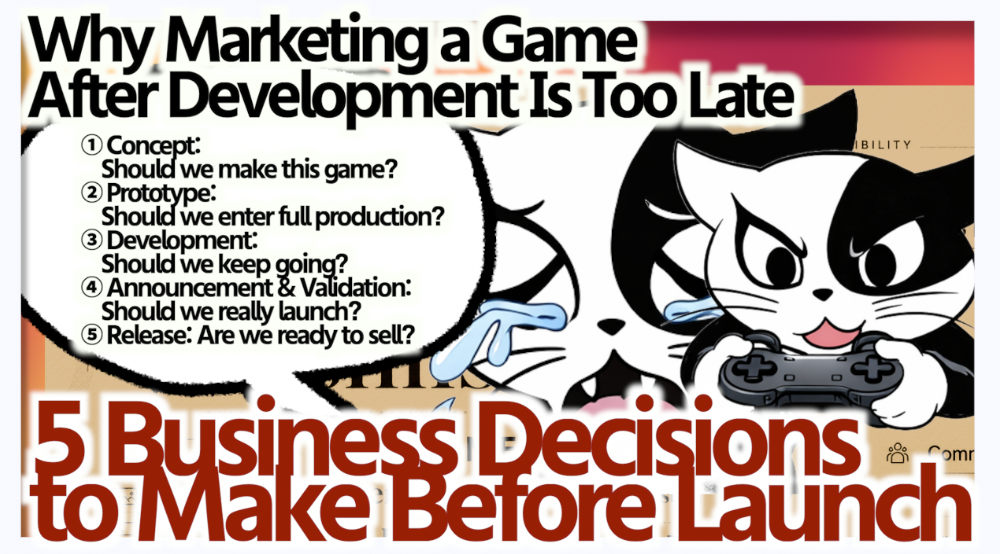
- Prototype Before Full Production
- The Real Lesson From MECCHA CHAMELEON
Why MECCHA CHAMELEON Sold 20 Million Copies—and Why Big Studios Struggle
MECCHA CHAMELEON has become one of the most remarkable indie game success stories of 2026.
The multiplayer hide-and-seek game launched on Steam in June 2026 and surpassed 20 million copies sold just over two months later. It was developed by only two people.
That alone is an extraordinary result.
But from a game business perspective, there is a more interesting question:
Why was a two-person indie team able to create this kind of hit—and why would a much larger game company struggle to reproduce the same model?
There is another question as well.
If indie developers want to create a breakout hit like this, how can they increase their odds instead of simply hoping to get lucky?
This article looks at MECCHA CHAMELEON from both sides: what made the game spread, what the two-person development structure made possible, why larger organizations face different constraints, and how both indie developers and major studios can improve their chances of creating the next hit.
What Is MECCHA CHAMELEON?
Before getting into the business analysis, it is worth establishing the basic facts.
| Item | Details |
|---|---|
| Development team | 2 people |
| Steam release | June 2026 |
| Sales | Over 20 million copies in just over two months |
| U.S. Steam price | $5.99 |
| Japanese price | ¥790 |
| Multiplayer | Online PvP, public matches, friend matches |
| Core development period | About 2 months |
| Engine | Unreal Engine |
| Matchmaking | Epic Online Services (EOS) |
Steam describes the game as a hide-and-seek game in which players paint their white bodies to blend into the environment. It supports public matches, playing with friends, and streamer-hosted viewer participation.
One detail needs clarification.
The game was developed in roughly two months, but that does not mean two developers built an entire online multiplayer game from zero in two months.
The developers have explained that if the work behind reused features from previous games is included, the total development effort was closer to four or five months. Systems from earlier projects such as Penguin Hotel and LINK Penguins were reused in MECCHA CHAMELEON.
That distinction is important.
This was not a sudden miracle created from nothing.
Previous games, previous failures, existing systems, and accumulated development experience all contributed to the final product.
5 Reasons MECCHA CHAMELEON Sold 20 Million Copies
So why did MECCHA CHAMELEON spread so far?
From a game business and marketing perspective, I see five major factors.
1. It Has Very Low Language Dependency
The core concept is hide-and-seek.
One team hides.
The other team looks for them.
The twist is that hiding players can paint their bodies to mimic walls, floors, objects, and the surrounding environment.
You can understand the basic idea simply by watching the game.
That matters enormously when a game needs to spread globally.
A game that requires players to understand large amounts of dialogue, story, tutorials, or complicated rules has a higher communication barrier.
MECCHA CHAMELEON can communicate its core appeal visually.
2. The Game Is Immediately Understandable
Language independence is only part of the advantage.
The basic system is also intuitive.
“Paint yourself to blend into the environment and hide.”
That sentence already explains most of the hook.
This gives the game an enormous advantage in terms of speed of understanding.
A viewer can see a short clip on social media and understand what is happening within seconds.
There is very little explanation required before the entertainment value becomes visible.
For a game competing for attention on TikTok, YouTube Shorts, X, Twitch, and other platforms, that is extremely powerful.
3. Multiplayer Creates Organic Distribution
MECCHA CHAMELEON is built around multiplayer.
That means one person discovering the game can potentially create several additional purchases.
Someone sees the game and says:
“This looks fun. Let’s play it tonight.”
Now their friends also need the game.
The Steam version supports playing with friends, public matches with strangers, and participation-based streams.
In other words, the game is not only a product.
Its multiplayer structure can also become part of its acquisition loop.
One user can bring in more users.
4. The Game Naturally Produces Shareable Content
MECCHA CHAMELEON is extremely compatible with streaming and short-form video.
A player hides perfectly.
A player paints themselves terribly.
Someone hides in a ridiculous position.
A Seeker walks directly past an obvious player.
Someone gets discovered instantly.
All of these moments work as entertainment even if the viewer has never played the game.
This is important because the game itself continuously generates marketing material.
The loop can look like this:
Game is played
↓
Funny or surprising moment happens
↓
Clip gets posted
↓
More people discover the game
↓
More people buy it
↓
More clips are created
That is a very strong structure for organic growth.
The developers themselves said overseas sharing was already increasing when the first trailer was released, and the scale of the international response exceeded their original expectations.
5. The Price Makes Curiosity Easy to Convert Into a Purchase
The U.S. Steam price is $5.99, while the standard Japanese price is ¥790.
That matters.
Imagine someone watching a funny MECCHA CHAMELEON clip.
They think:
“That looks fun.”
At $5.99, the next thought can easily be:
“I’ll just buy it.”
Now imagine the same game costs $30 or $50.
The decision changes.
“Is it actually good?”
“Maybe I should read reviews.”
“Should I buy something else instead?”
“Will my friends actually play it?”
The higher the price, the more evaluation enters the purchase decision.
A low price reduces the perceived cost of making the wrong choice.
That makes it easier to convert viral attention into actual sales.
Global Reach Matters at the 20 Million Copy Level
If a game is going to grow to the scale of 20 million copies, global sales become extremely important.
That is why the combination of low language dependency, visual readability, multiplayer, social-media compatibility, and low purchase friction matters so much.
These are not simply five isolated strengths.
They reinforce one another.
The game is easy to understand.
That makes it easy to watch.
It is easy to watch, so it spreads.
It is multiplayer, so users invite friends.
It is inexpensive, so those users can convert into buyers relatively easily.
The entire structure works together.
Why a Two-Person Development Team Was an Advantage
The obvious advantage of having only two developers is lower cost.
But cost is not the only advantage.
One of the biggest advantages is decision-making speed.
“This is not fun.”
Change it.
“We do not need this feature.”
Remove it.
“We can reuse this system from the previous game.”
Use it.
Two people can make those decisions immediately.
That creates another advantage:
rapid iteration.
Build.
Play.
Change.
Play again.
Repeat.
The developers have explained that their approach is to first create the entire game using the minimum necessary systems and graphics, get it into a playable state, and then continue adding and improving elements from there.
That is essentially prototype-driven development.
Instead of spending a long time building toward an imagined finished product, they create something playable early and use the actual game experience to guide development.
The speed of that loop matters.
During pre-release playtesting, feedback suggested the game needed more maps.
The team then created three additional maps only two weeks before launch.
That kind of response speed is one of the strongest weapons a tiny development team can have.
Small Teams Also Have Different Incentives
There is another structural difference.
When two independent developers are making their own game, they are not only developers.
They are also the people directly exposed to the business outcome.
They decide:
How much time should we spend?
Where should we spend money?
What should we cut?
When should we launch?
Should we continue?
Should we stop?
If the game fails, the consequences come back to them directly.
This does not mean independent developers are “better” or employees are “worse.”
The incentive structure is simply different.
Small teams can combine product decisions and business decisions in the same room—sometimes literally between two people.
That can create a level of speed that becomes much harder to reproduce as an organization grows.
The Real Story Behind the “Two-Month Development”
Another major lesson from MECCHA CHAMELEON is the value of previous development assets.
The headline is:
“Two people made a 20-million-copy game in about two months.”
But the more important business lesson may be what happened before those two months.
Previous games existed.
Previous systems existed.
Previous failures existed.
Development knowledge already existed.
The developers reused systems from earlier projects rather than rebuilding everything from scratch.
That turns failure into an asset.
Instead of thinking:
Previous game failed
↓
Everything is discarded
↓
Next game starts from zero
the better model is:
Previous game failed
↓
Code remains
Systems remain
Assets remain
Knowledge remains
↓
Next project starts ahead of zero
This is especially important for indie developers.
If every new game requires rebuilding everything from scratch, development becomes extremely expensive in both money and time.
A failed game does not mean every piece of work inside that game has failed.
Code can still have value.
Tools can still have value.
Art pipelines can still have value.
Systems can still have value.
Knowledge certainly has value.
The question is whether those assets become part of the next project.
Why Big Game Companies Struggle to Replicate This Model
Large game companies have many advantages that indie developers do not.
They have:
- experienced developers
- capital
- technology
- QA organizations
- localization resources
- marketing power
- distribution relationships
- established brands
So why would they struggle to create something like MECCHA CHAMELEON?
The problem is not ability.
The problem is economic structure and organizational structure.
Bigger Organizations Need Bigger Business Outcomes
Imagine a game being developed by ten employees instead of two independent developers.
Ten salaries are now attached to the project.
If development is extended by three months, those ten people need to remain on the project for another three months.
Then add:
management
QA
production
localization
marketing
legal support
platform operations
and other overhead.
The project now has a very different cost structure.
That changes what the company needs from the game financially.
A $5.99 game may be perfectly viable for a tiny team.
The same price point may be much harder to justify inside a larger organization depending on the cost structure and required return.
And once the required revenue grows, other pressures appear.
“We need more content.”
“We need more characters.”
“We need more production value.”
“We need more features.”
“We need a higher price.”
The cycle can become:
Higher cost
↓
Higher required revenue
↓
Higher price or larger sales target
↓
Higher quality and content expectations
↓
Even higher cost
The original small, focused concept gradually becomes a larger project.
This is not because large companies are making bad decisions.
Those decisions can be completely rational inside their economic structure.
The problem is that the structure itself can make certain kinds of small games difficult to produce.
Large Organizations Can Also Struggle to Reuse Failure
There is another issue: reuse.
A cancelled project may still contain valuable code.
A discontinued live-service game may contain useful systems.
A failed prototype may contain a mechanic that could work somewhere else.
But in a large organization, reuse can become difficult.
The development team is different.
The producer is different.
The external vendor is different.
The technology stack is different.
The contracts may be different.
The project may have been reorganized.
The people who learned from the failure may no longer be working together.
A company may clearly understand that an IP is an asset.
But what about:
code from a failed game?
an abandoned prototype?
an internal tool?
a multiplayer system?
development knowledge from a cancelled project?
Those can also be assets.
The challenge is creating an organization that can actually transfer them into the next opportunity.
Could MECCHA CHAMELEON Have Passed a Major Publisher’s Greenlight Process?
This may be the most interesting question in the entire case.
MECCHA CHAMELEON has already sold more than 20 million copies.
Looking at the game today, it is easy to say:
“That was a great idea.”
But what if the same concept had been presented to a major publisher before release?
Would it have passed the greenlight process?
This is not a fact. It is a hypothesis.
But imagine the meeting.
“What is the total addressable market?”
“How many copies do we expect to sell?”
“What evidence supports that forecast?”
“Who are the competitors?”
“Is there enough content?”
“Will players really pay for this?”
“Should we add more features?”
These are normal questions inside a company.
When significant corporate resources are being allocated, management needs a logical explanation for why the project deserves investment.
But there is a problem.
Nobody could have logically proven before launch that MECCHA CHAMELEON would sell 20 million copies.
Its original sales goal was only 100,000 copies. The eventual result exceeded that target by more than 200 times.
And if a small concept needs to become more “defensible” in a greenlight meeting, the team may start adding:
more features
more content
more visual polish
more production value
a larger revenue model
Those additions may make the business case easier to explain.
But they can also destroy the very characteristics that made the original game powerful:
simplicity
speed
low cost
low price
immediate readability
The issue is not that major publishers cannot create hit games.
Of course they can.
The question is whether a normal large-company approval system is good at identifying and protecting small, sharp, uncertain opportunities before the market has validated them.
Big Studios Should Not Copy the Game
If a major game company looks at MECCHA CHAMELEON and concludes:
“We should make a hide-and-seek game too,”
it has learned the wrong lesson.
The game should not be copied.
The operating model should be studied.
One possible approach would be to create tiny internal development cells.
For example:
- 2 people
- 3 to 6 months
- limited budget
- significant product decision authority
- separate approval process from major productions
- mandatory use of existing internal development assets
The constraint itself matters.
The question becomes:
“What can two people build in six months using things this company already owns?”
That could include:
old code
unused systems
assets from cancelled projects
abandoned prototypes
internal tools
technology from discontinued titles
The goal would not necessarily be to ship a finished game.
The goal could be to produce several prototypes.
If one is weak, stop.
If one shows strong user response, then scale it.
Operate Like an Indie Before the Signal—Then Become a Big Company
This is where the large company becomes powerful.
Before there is evidence of demand:
operate like an indie.
Small team.
Low cost.
Fast decisions.
Fast iteration.
Minimal approval.
After strong market signals appear:
use the power of the large company.
Add developers.
Add QA.
Add localization.
Add marketing.
Add console versions.
Use platform relationships.
Use global distribution.
In other words:
Before the signal: indie operating model
After the signal: big-company power
If a major publisher can genuinely combine those two modes, it could become much stronger.
It would have:
the agility of an indie team
×
the capital, talent, technology, marketing, and distribution of a large company
That is far more interesting than simply copying whatever indie game is currently successful.
Does Selling 20 Million Copies Mean Every Decision Was Correct?
There is one more important point.
MECCHA CHAMELEON sold more than 20 million copies.
But that does not mean the developers knew how to create a 20-million-copy game with certainty.
The developers originally targeted 100,000 copies.
The result exceeded that target by more than 200 times.
They also said they initially expected the game to mainly become a topic of conversation in Japan and were surprised by the scale of overseas interest.
That distinction matters.
Selling 20 million copies
is not the same as
fully understanding in advance how to sell 20 million copies.
This is not criticism of the developers.
A game does not reach this level without skill, good decisions, and a product users genuinely enjoy.
But games also contain variables that cannot be fully controlled.
Timing.
Competition.
Streamers.
Social media.
Word of mouth.
Cultural momentum.
The next game is not automatically going to sell 20 million copies simply because the previous one did.
And this is not unique to indie developers.
The same thing happens at large companies.
The game industry has many examples of titles that performed far beyond internal expectations.
The important question is what happens after the unexpected hit.
Turning Luck Into Organizational Capability
Getting lucky is not the problem.
Wasting the luck is.
A strong game company does not simply celebrate an unexpected hit and move on.
It asks:
Why did people buy it?
Which users responded most strongly?
What made it different from competing games?
Why did people keep playing?
Why did they share it?
What should be preserved?
Then it converts those answers into assets.
The process looks like this:
Luck
↓
Analysis
↓
Asset creation
↓
Higher repeatability
↓
Franchise or sustainable business
A hit may begin with luck.
But the organization does not have to remain dependent on luck.
It can turn the result into:
IP
brand value
community
development knowledge
technology
marketing knowledge
future products
That is how a lucky hit gradually becomes company capability.
The dangerous alternative is becoming dependent on the one game that happened to succeed.
Years later, the company is still extending the same title.
No new hit appears.
Revenue declines.
The company no longer understands how to create another winner.
At that point, it is no longer a company that creates hits.
It is a company being kept alive by a hit it created years ago.
How Indie Developers Can Increase Their Odds of Success
So how can developers reduce the role of luck?
Luck can never be eliminated.
But the probability of success can be improved.
The first step happens before development.
Look for a gap in the market.
In formal business language, this is part of market strategy.
But it does not need to be complicated.
Ask:
Where could this game realistically win?
Are you entering a category already filled with similar games?
Is there an experience players want that existing games are not providing well?
Why would someone buy your game instead of another game?
What is the reason for choosing you?
These questions should be considered before full production begins.
Prototype Before Full Production
The next step is the prototype.
Do not begin by building the complete game.
Build the smallest version that allows you to test the core experience.
Then put it in front of target users.
Ask:
Is it actually fun?
Do players understand it immediately?
Do they want to play again?
Do they want to show it to friends?
Does the game create moments people want to share?
Does a short video make viewers interested?
MECCHA CHAMELEON itself used a development approach built around getting the basic game playable early, testing it, and then improving it based on actual play.
From a business perspective, the process should look something like this:
Market gap
↓
Prototype
↓
External user test
↓
Full production
If the response is weak, change the game while the cost is still low.
If the response remains weak, stop.
If the response is strong, invest more.
This does not guarantee a 20-million-copy game.
Nothing can.
But it can increase the probability of finding something that works before the company has already spent most of the budget.
The Real Lesson From MECCHA CHAMELEON
The lesson from MECCHA CHAMELEON is not:
“Two people can beat major publishers.”
That is too simplistic.
Indie developers have advantages:
speed
low cost
fast iteration
direct decision-making
flexibility in reusing previous work
Major game companies have different advantages:
capital
talent
technology
QA
localization
marketing
platform relationships
distribution
brand power
The real opportunity is to combine the strongest parts of both models.
Large companies can create environments where tiny teams are allowed to operate like indie developers before a concept has been validated.
Indie developers can become more strategic by thinking about market gaps, prototypes, external validation, and business viability before committing to full production.
A hit can never be made completely predictable.
But luck does not have to be the entire strategy.
You can decide where to compete.
You can build small.
You can test early.
You can listen to real users.
You can reuse what you already created.
You can stop weak ideas before they become expensive.
And when something starts working, you can invest aggressively.
The most valuable lesson from MECCHA CHAMELEON is not the game itself.
It is the way a small team was able to build, test, reuse, decide, and move quickly.
Do not copy the game.
Study the operating model that made the game possible.