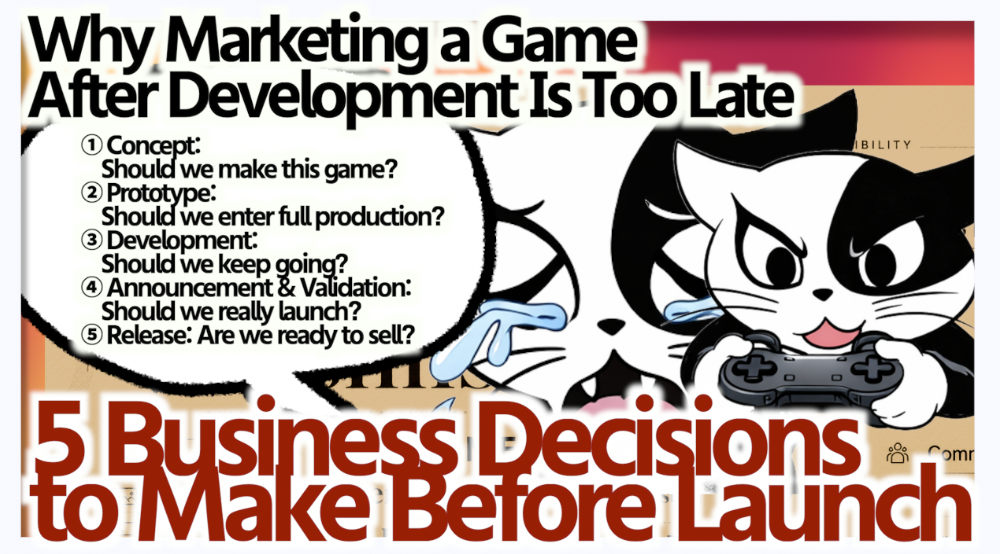
- Why Marketing a Game After Development Is Too Late: 5 Business Decisions to Make Before Launch
- 1. Concept: Should We Really Make This Game?
- 2. Prototype: Should We Move Into Full Production?
- 3. Full Development: Should We Keep Building It This Way?
- 4. Announcement and Demand Validation: Should We Really Launch?
- 5. Release: Are We Actually Ready to Sell It?
- Do Not Separate Game Development From Game Marketing
- Toroneko Supports Game Business Decisions From the Concept Stage
Why Marketing a Game After Development Is Too Late: 5 Business Decisions to Make Before Launch
The game is finished.
Now comes the question:
“How are we going to sell this?”
If this is the first time the team is seriously thinking about how to market the game, it may already be too late.
I believe the commercial side of a game should be considered before development begins.
At the concept stage, I look at questions such as:
- Who is going to play this game?
- Is there a real market for it?
- Can this team realistically finish it?
- Is the investment justified?
- How will we reach players once the game is finished?
And even after development begins, the decision-making does not stop.
We continue asking:
- Should we keep going?
- Should we go back and rethink something?
- Should we rebuild part of the game?
- Should we stop the project entirely?
Game development and game marketing should not suddenly meet for the first time at launch.
Building the game and selling the game should be treated as one business process from the beginning.
In this article, I will explain five key decision points that can help small and mid-sized game companies and indie developers reduce avoidable failures.
| Phase | Key Decision |
|---|---|
| 1. Concept | Should we really make this game? |
| 2. Prototype | Should we move into full production? |
| 3. Full Development | Should we keep building it this way? |
| 4. Announcement & Demand Validation | Should we really launch it? |
| 5. Release | Are we actually ready to sell it? |
Following this process does not guarantee a hit.
There are no guarantees in the game business.
But it is possible to reduce some of the failures that could have been avoided before spending large amounts of money and time.
1. Concept: Should We Really Make This Game?
A team comes up with an exciting game idea.
The natural reaction is:
“Let’s make it.”
I would not move directly into full production.
The first question is:
Who is this game actually for?
Understand the Target Player
At a minimum, I want to understand:
- What games are these players currently playing?
- Why are they playing those games?
- What frustrations do they have with existing games?
- Why would they choose our game instead?
It is not enough to say:
“We are making a fun game.”
The real question is:
Fun for whom?
Is There a Market?
Next comes market potential.
A development team may genuinely believe that a game is interesting.
But if very few people actually want that kind of game, turning it into a viable business becomes much harder.
So we look at questions such as:
- Are there similar games already on the market?
- Is there an existing audience?
- How strong is the competition?
- Is this better suited to Steam or mobile?
- Which market are we actually trying to compete in?
A large market does not automatically mean success.
A small market does not automatically mean the project should be rejected.
What matters is making the investment decision with a realistic understanding of the market.
Does the Investment Make Sense?
A game that costs $100,000 to build and a game that costs $1 million require very different levels of commercial success.
So the team should consider:
- How much are we willing to invest?
- How much revenue would be needed to justify that investment?
- Is the market large enough to support that outcome?
- Can the company realistically accept the downside risk?
A game should not receive a green light simply because the idea sounds fun.
There also needs to be a reason to believe the project makes sense as a business.
Can the Team Actually Finish It?
Another major question is feasibility.
- Do we have enough people?
- Do we have enough budget?
- Can we technically build what we are planning?
- Is the development schedule realistic?
- Is the amount of content and asset production manageable?
- If this is a live-service game, can we support it after launch?
A concept may sound great on paper.
But a great concept that never gets finished is still a failed business project.
Think About How the Game Will Sell Before It Exists
There is one more thing I think about during the concept stage:
How will this game sell once it is finished?
The game may not even exist yet.
But I still want to ask:
- Can the core appeal be explained in one sentence?
- Does the game look interesting in a short video?
- Does it contain moments people would want to share?
- Is it suitable for streamers and content creators?
- Would players want to recommend it to friends?
- Is the price easy to understand and accept?
This becomes especially important for small and mid-sized game companies and indie developers.
They usually cannot compete with large publishers by spending the same amount on advertising.
So another question becomes important:
Can the game itself contain elements that make it easier to spread?
For example:
- Low dependence on language
- Easy-to-understand gameplay at a glance
- Intuitive systems
- Multiplayer interactions that create unexpected moments
- Strong compatibility with streams, clips, and Shorts
- A price that lowers the barrier to trying the game
Not every game needs all of these elements.
Some of them may not fit the product at all.
But if a company cannot rely on large advertising budgets, it is worth asking:
Can we build some form of organic spread into the product itself?
Do not build the game first and think about marketing later.
Design the game and its path to market together from the beginning.
That is a core part of how I think about game marketing.
2. Prototype: Should We Move Into Full Production?
Once the concept is strong enough, the next step is a prototype.
The important thing here is:
Do not let the creators alone decide whether the game is fun.
Developers already know:
- The rules
- The controls
- Where the interesting parts are
- How the game is supposed to be played
A new player does not know any of those things.
So I want the prototype to be tested by the actual target audience.
Watch What Players Actually Do
Some of the things to observe include:
- Can they play without excessive explanation?
- Do they enjoy the part we expected them to enjoy?
- Do they want to play again?
- Where do they stop?
- Do they behave differently from what we expected?
- Do they ignore the part we believed was the main appeal?
However, there is an important distinction here.
Players should not be asked to design the game for us.
We are not asking:
“What game should we make?”
The company still makes the final decisions.
What we want from players is:
evidence that the development team cannot get from inside the company alone.
Small Teams Need External Decision Inputs
Small and mid-sized game companies often have fewer people involved in decision-making than major publishers.
That can be a major advantage.
They can make decisions quickly.
They can:
- Move forward
- Go back
- Change direction
- Stop
without going through layers of internal approval.
But there is also a risk.
A small team can become trapped inside its own assumptions.
That is why involving target players early can be so valuable.
It brings external evidence into the decision-making process.
GO, REWORK, or STOP
After reviewing the prototype, I like to keep the decision simple.
| Decision | Meaning |
|---|---|
| GO | Move forward |
| REWORK | Fix the problems and test again |
| STOP | End the project here |
Building a prototype does not mean the team is obligated to enter full production.
If the reaction is weak, rework it.
If the fundamental idea does not hold up, stop.
Stopping at this stage is not necessarily a failure.
It may be the decision that prevents a much larger failure later.
Before full production, failure is still relatively inexpensive.
3. Full Development: Should We Keep Building It This Way?

If the prototype is strong enough to receive a GO decision, full development begins.
But that does not mean the major decisions are over.
During development:
- The schedule may slip
- Costs may rise
- New features may be proposed
- Competitors may launch similar games
- Market conditions may change
- Key team members may leave
Things rarely go exactly according to the original plan.
So the team should keep reviewing questions such as:
- Is this new feature really necessary?
- Does it strengthen the reason players would choose this game?
- Can we still finish within the planned budget?
- Is the release schedule still realistic?
- Is the original core appeal of the game still intact?
When necessary, the team may need to:
- Cut features
- Reduce scope
- Change direction
- Delay the release
And in some cases, the correct decision may still be to stop.
One of the most dangerous situations in game development is:
“We have already spent this much, so we have no choice but to finish.”
Finishing the game is not the ultimate goal.
Building a commercially viable business is the goal.
4. Announcement and Demand Validation: Should We Really Launch?
There is a specific problem small game companies and indie developers face.
Simply announcing a game does not mean players will notice it.
Large publishers may be able to use:
- Brand recognition
- Existing communities
- Large advertising budgets
to create awareness quickly.
Smaller companies usually cannot compete in the same way.
That means they should not wait until the announcement to begin building an audience.
Player touchpoints should be created earlier.
Small Companies Can Use Time as an Advantage
This could be through:
- A website
- YouTube
- X
- A community
The goal is not to operate every possible channel.
The goal is to build at least one place where the company can repeatedly reach people who are likely to care about the game.
Large companies can spend money to create awareness quickly.
Smaller companies can use something else:
time.
If development will take one or two years, that development period can also be used to gradually build relationships with potential players.
The goal is simple:
Do not begin launch day with an audience of zero.
Announcement Is Also Demand Validation
Once the game is announced, the market starts giving you real feedback.
For a Steam game, that may include:
- Wishlists
- Demo activity
- Playtest participation
- Social media reactions
- Streamer and creator interest
For a mobile game, that may include:
- Pre-registrations
- Paid acquisition tests
- Social media response
- Video response
The exact method varies.
The important question is:
Do people actually want this game before it launches?
Weak Response Does Not Automatically Mean Weak Marketing

If the reaction is poor, it is dangerous to immediately conclude:
“We need more advertising.”
or
“We just need more awareness.”
The real problem may be somewhere else.
For example:
- The market was misunderstood at the concept stage
- The target audience was wrong
- The prototype was not validated strongly enough
- The game lost some of its original appeal during development
- The game is good, but the message is weak
- The actual demand is smaller than expected
Different causes require completely different solutions.
The correct response may be to:
- Change the positioning
- Improve the game
- Delay the launch
And in some cases:
do not launch it.
The logic should not be:
“We spent this much, so we have to release it.”
The fact that a large amount has already been invested is precisely why one more serious business decision may be necessary.
5. Release: Are We Actually Ready to Sell It?
By this point, the team should already have considered:
- Who the game is for
- Whether the market exists
- Whether the investment makes sense
- Whether the team can finish it
- How the game will eventually be sold
The prototype has been tested with target players.
Business decisions have continued throughout full production.
Player touchpoints have been built before launch.
Demand has been tested after announcement.
If all of that work has already happened, launch day should not begin with:
“So… how do we sell this game?”
The team should already have a working hypothesis for:
Who we are reaching, what we are offering, why they should care, and how we will reach them.
Launch becomes the point where those hypotheses are executed and tested in the real market.
Of course, a game can still fail after doing all of this.
Nothing guarantees commercial success.
But the team has continuously:
- Tested
- Evaluated
- Returned when necessary
- Improved
- Stopped when necessary
That process can reduce the number of failures that only become obvious after the company has already spent too much money and time.
Do Not Separate Game Development From Game Marketing
The five decision points can be summarized like this:
| Phase | Decision |
|---|---|
| Concept | Should we really make this game? |
| Prototype | Should we move into full production? |
| Full Development | Should we keep building it this way? |
| Announcement & Demand Validation | Should we really launch it? |
| Release | Are we actually ready to sell it? |
The key idea is simple:
Marketing should not be treated only as promotion after development is finished.
Marketing also means:
- Understanding the market
- Understanding the target player
- Understanding competitors
- Thinking about how the product will be sold
- Feeding that information back into product and business decisions
Building the game and selling the game should be treated as one continuous business process.
That is the basic framework I use when looking at game businesses.
Toroneko Supports Game Business Decisions From the Concept Stage

When I work with game companies, I do not only look at promotion after the game has been completed.
I support decision-making from concept through launch, including whether the project should continue in its current form.
At the concept stage, that can include:
- Market potential
- Target players
- Investment size
- Development feasibility
- How the finished game will reach players
If a prototype already exists, we can look at whether the project should:
- GO
- REWORK
- STOP
based on actual target-player response.
If the project is already in full development, we can look at:
- Whether development should continue as planned
- When the game should be announced
- How demand should be validated
- What business decisions still need to be made before launch
Small and mid-sized game companies often cannot have separate specialists for:
- Market analysis
- Marketing
- Business strategy
- Development
inside the company at all times.
That is why it can be useful to combine:
internal development and business judgment
with
external business and marketing perspective
and
evidence from actual target players.
This increases the amount and quality of information available when making major decisions.
If your team is building a game but is unsure whether the project should continue as it is, wants to connect product and marketing decisions earlier, or wants to avoid reaching the end of development and asking:
“How are we going to sell this?”
feel free to contact Toroneko.