- Why Do Global Games Fail in Japan? Localization Alone Isn’t Enough: A 3-Stage Framework for Japan Market Adaptation
- Stage 1: Language Fit — Make the Product Understandable in Japanese
- Stage 2: Culture Fit — Make the Product Feel Natural in Japan
- Stage 3: Market Fit — Adapt to the Japanese Audience You Actually Want to Win
- The Same Game May Need a Different Positioning in Japan
- Market Fit Only Gets You to the Same Starting Line as Japanese Competitors
- The Hardest Part of Entering Japan Is Often Not Translation — It Is Decision-Making
- A Japan Head Cannot Create Market Fit Without Decision-Making Authority
- “It Worked Overseas” Is Not a Reason Japanese Players Will Choose It
- More Promotion Cannot Fix a Lack of Market Fit
- Do Not Outsource Japan Market Strategy Entirely to an Agency
- The Same Problem Appears Outside the Game Industry
- I Noticed the Same Pattern Through CrossFit
- Seven Questions Executives Should Ask Before Entering Japan
- 1. Who exactly is the customer in Japan?
- 2. What currently takes that customer’s time and money?
- 3. Why should that customer switch to your game?
- 4. Does the value that worked overseas still have value in Japan?
- 5. What should be changed for Japan?
- 6. What should not be changed?
- 7. Who makes the final decision?
- Japan Market Entry Requires More Than Localization
- Talk to Toroneko About Your Game Business in Japan
Why Do Global Games Fail in Japan? Localization Alone Isn’t Enough: A 3-Stage Framework for Japan Market Adaptation

A game succeeds overseas.
The company localizes it into Japanese.
It launches a Japanese website.
It creates Japanese social media accounts.
It hires local staff and starts running ads in Japan.
And yet, the game still fails to perform as expected.
This is a pattern I have seen repeatedly in the game industry.
When that happens, the conclusion is often:
“Japan is a difficult market.”
“Japanese players simply did not like the game.”
But before reaching that conclusion, there is another question worth asking.
Did the company actually enter the Japanese market?
Or did it simply take a successful global product, translate it into Japanese, and place it in Japan?
Translating a product into Japanese and building a product that can compete in Japan are two very different things.
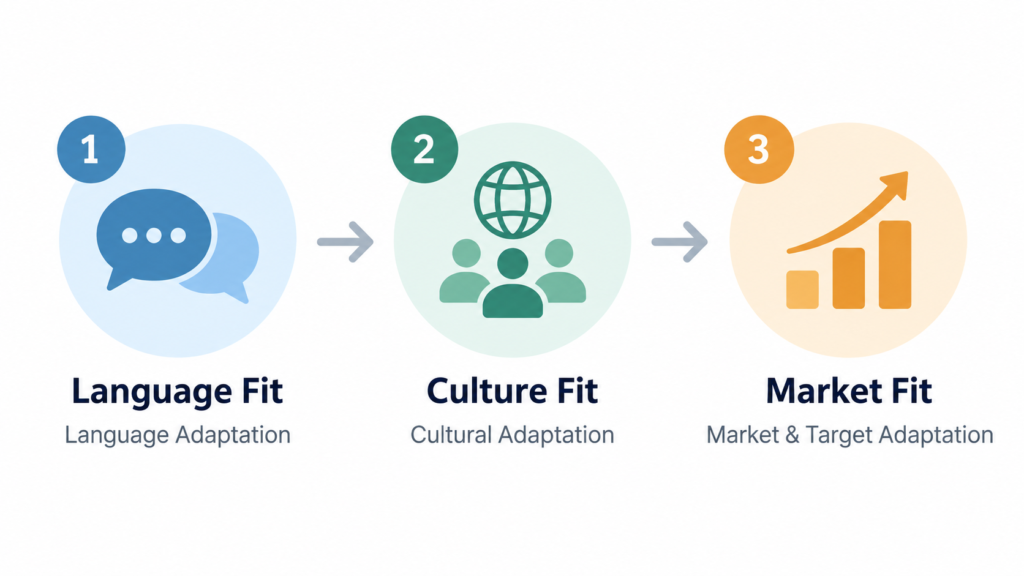
When bringing a product into the Japanese market, I believe there are three distinct stages of adaptation.
The first is making the product understandable in Japanese.
The second is adapting it so that it feels natural within Japanese culture and user expectations.
The third is adapting the product, positioning, and go-to-market strategy for the specific Japanese audience you actually want to win.
In this article, I refer to these three stages as:
Language Fit
Culture Fit
Market Fit
I use the term “Japan Market Fit” in this article as a practical framework rather than as a formally established marketing term.
It describes the process of adapting an overseas product to the specific customers it needs to win in the Japanese market.
And one point is especially important:
Reaching the third stage does not guarantee success.
It simply means you are finally ready to compete.
Stage 1: Language Fit — Make the Product Understandable in Japanese

The first stage is Language Fit.
This includes translating:
- In-game text
- UI
- Store descriptions
- Subtitles
- Customer support
- Marketing copy
into natural and accurate Japanese.
This is obviously necessary.
Poor Japanese can create distrust before players even experience the game itself.
Players may begin wondering:
“Is this game properly supported?”
“Can I trust this publisher?”
So translation quality matters.
But there is an important distinction.
A game being understandable in Japanese does not mean Japanese players will want to play it.
Language Fit is simply the minimum requirement for entering the market.
Stage 2: Culture Fit — Make the Product Feel Natural in Japan

The second stage is Culture Fit.
This is close to what is often called culturalization.
It goes beyond translating individual words and sentences.
It may involve adapting:
- Character dialogue
- Tone and worldbuilding
- Visual expression
- UI and UX
- In-game events
- Monetization presentation
- Social media communication
- Live operations
to Japanese cultural expectations and user behavior.
A line of dialogue may be technically correct but still sound unnatural for the character.
A user flow that works overseas may create unnecessary friction for Japanese users.
A sales tactic that is accepted in another market may feel overly aggressive or suspicious in Japan.
At this stage, the product begins to move from:
“a global game translated into Japanese”
to:
“a game that feels natural to Japanese users.”
But even this is not enough.
Because Culture Fit is still targeting a very broad group:
Japanese people.
And Japanese players are not a single audience.
Stage 3: Market Fit — Adapt to the Japanese Audience You Actually Want to Win

The third stage is Market Fit.
This is where marketing truly begins.
The question is no longer:
“Does this game feel natural to Japanese players?”
The question becomes:
“Who exactly are we trying to win in Japan?”
Even within the Japanese market, different players value very different things.
Some care primarily about characters.
Some care about story.
Some are highly competitive and love PvP.
Some enjoy collecting and progression.
Some want short, lightweight play sessions.
Some are strongly attracted to a particular genre, IP, art style, or world.
Once the target audience changes, many other decisions may also change:
- Which characters you put front and center
- Key visuals
- App store screenshots
- Messaging
- Ad creatives
- Events
- Monetization
- First-purchase design
- Community strategy
- Influencers
- Media strategy
Market Fit means taking the value created by a global product and translating that value into something meaningful for the specific Japanese audience you want to reach.
In simple terms:
Language Fit means “I understand it.”
Culture Fit means “It feels natural to me.”
Market Fit means “I want it.”
The Same Game May Need a Different Positioning in Japan

Imagine a game that became successful overseas because of its competitive PvP.
The global marketing may focus heavily on:
“Compete against players around the world.”
“Climb the rankings.”
You could use the same positioning in Japan.
But what if market analysis shows that the game has much greater potential among Japanese players who are more attracted to its characters, collection systems, or worldbuilding?
The game itself may not need to be rebuilt.
But many things around it may need to change.
Which characters appear in the advertising.
The store screenshots.
The messaging.
The events.
The social media strategy.
The influencers.
The media coverage.
A product positioned overseas as:
“a competitive PvP game”
could potentially be positioned in Japan as:
“a game about collecting and developing characters you love.”
Whether that is the right decision depends entirely on the individual title.
The important point is this:
Do not treat the way a game was successfully marketed overseas as something that must never be changed.
The product may remain the same while its meaning within the market changes.
That is Market Fit.
Market Fit Only Gets You to the Same Starting Line as Japanese Competitors

This is another critical point.
Achieving Market Fit does not mean you will succeed in Japan.
It means you are finally in a position to compete.
Japanese game companies are already operating inside the Japanese market.
They know the competition.
They understand what Japanese players are currently playing.
They see which characters are popular.
They know what kind of advertising is common.
They understand local monetization expectations.
They see how players react on Japanese social platforms.
They develop and market their games inside this environment from the beginning.
A global publisher entering Japan with only Language Fit is already at a major disadvantage.
Even after achieving Culture Fit, the company may only have created:
“a product that does not feel foreign.”
Japanese competitors are already trying to create:
“a product that specific Japanese users will actively choose.”
That is why even reaching Market Fit does not guarantee victory.
It only means you are finally ready to compete.
The Hardest Part of Entering Japan Is Often Not Translation — It Is Decision-Making

In many cases, the biggest challenge in bringing a global game to Japan is not translation.
It is not advertising either.
The real challenge is further upstream.
It is business decision-making.
The more successful a game has already been globally, the harder this can become.
The title has performed well.
The numbers are strong.
The same model has worked across multiple regions.
From HQ’s perspective, the natural question becomes:
“Why should Japan be different?”
Changing a successful product can look like breaking something that already works.
Meanwhile, the Japan team may be thinking:
“This will not work in Japan as it is.”
But the local team may not have the authority to change the product, pricing, monetization, or live operations.
So the result becomes:
The game cannot change.
The pricing cannot change.
The operating model cannot change much.
So only the language and advertising change.
At that point, the Japan team may officially be responsible for marketing, while in reality it only has authority over promotion.
A Japan Head Cannot Create Market Fit Without Decision-Making Authority
This is a structural issue that can affect many overseas companies.
A Japan Head or Country Manager may understand the Japanese market very well.
They may believe:
“This character should be the main focus.”
“This price point will be difficult in Japan.”
“We should redesign the first purchase.”
“The global ad message will not resonate here.”
But HQ may respond:
“It works in every other market.”
“We need to maintain a consistent global brand.”
“We cannot change the development schedule.”
When this happens, the problem is not necessarily the marketing ability of the Japan team.
The problem is the decision-making structure.
That does not mean HQ should simply give Japan complete freedom either.
Over-adapting a product can damage the core experience or weaken a global brand.
The company still needs to decide:
What should change?
What should remain unchanged?
Why?
And who has final decision-making authority?
The Japan team also needs to do more than simply say:
“Japan is different.”
It needs to explain, using market data, competitors, users, and business logic:
why a change is necessary in Japan.
“It Worked Overseas” Is Not a Reason Japanese Players Will Choose It
A strength that helped a game succeed overseas may not remain a strength in Japan.
The reason is simple.
The competitive environment changes.
A game mechanic that was unique overseas may already be common in Japan.
A character design praised in another market may disappear among dozens of strong local competitors.
A pricing advantage elsewhere may not matter because Japanese players use completely different criteria when choosing what to play.
So the question should not only be:
“What is good about our game?”
It should also be:
“Why would this game be chosen in Japan?”
Global success is a valid reason to consider entering Japan.
But it is not, by itself, a reason Japanese users will choose the product.
More Promotion Cannot Fix a Lack of Market Fit
When a game underperforms in Japan, companies often respond by increasing promotion.
Spend more on ads.
Hire influencers.
Run social media campaigns.
Launch collaborations.
Increase PR.
Run a major launch campaign.
But if the product lacks Market Fit, adding more promotion will not solve the underlying problem.
It may simply increase the amount of money being spent in the wrong direction.
For example, an ad creative that does not accurately reflect the actual game may reduce CPI.
But if players install the game expecting one experience and receive something completely different, many will leave.
A low CPI does not mean the business is healthy.
Acquiring users and growing the business are not the same thing.
Promotion cannot replace Market Fit.
Do Not Outsource Japan Market Strategy Entirely to an Agency

Global game companies entering Japan often work with Japanese advertising agencies, PR firms, localization companies, or marketing partners.
There is nothing wrong with outsourcing:
Advertising operations.
Media buying.
Creative production.
PR.
Influencer campaigns.
Localization.
The problem begins when the company also outsources questions such as:
Who should we target in Japan?
What should we position as the core value?
Who are our real competitors?
What should we change in the product?
Those are business decisions.
An advertising agency can run ads.
A creative agency can produce assets.
A localization company can translate the game.
But someone still needs to decide:
How should this game compete in the Japanese market?
If neither HQ nor the Japan team owns that decision, the company has effectively outsourced its entire Japan market entry strategy.
The Same Problem Appears Outside the Game Industry
This pattern is not unique to games.
Companies in automotive, retail, apps, SaaS, digital services, fitness, and many other industries have repeatedly entered Japan after succeeding overseas.
They translate the product.
They establish a local office.
They run advertising.
And still, the business does not perform as expected.
The problem is often not the product itself.
It may be the connection between the product and the market:
The target audience.
The competitive environment.
Pricing.
Distribution.
Trust.
Positioning.
The buying process.
Sometimes even the product itself.
In other words:
Language Fit and Culture Fit do not automatically create Market Fit.
I Noticed the Same Pattern Through CrossFit
I personally do CrossFit on a regular basis.
CrossFit is a global fitness brand with many Affiliates around the world, including Japan.
CrossFit HQ also provides marketing resources for Affiliates and continues to develop localized materials for different regions.
Those efforts are useful.
But as someone who actually does CrossFit, I found myself asking a familiar question:
Will Japanese marketing materials alone make CrossFit grow in Japan?
Even with the same CrossFit product, the value proposition changes depending on who you are targeting.
Competitive athletes.
Office workers in their 30s and 40s.
Women with limited training experience.
People in their 50s focused on maintaining long-term fitness.
People looking for community.
People who first became interested in fitness racing.
The product may be the same.
But the meaning of that product changes depending on the target.
Meanwhile, HYROX has a very easy-to-understand proposition.
Run.
Complete standardized workout stations.
Record a time.
Compete in an event.
I am not arguing that HYROX is better than CrossFit.
What interests me is something else.
The same problem I have seen repeatedly in the game industry—assuming that a strong product only needs to be localized—also appears in completely different industries.
Having a good product and making the market understand why it should choose that product are two separate challenges.
Seven Questions Executives Should Ask Before Entering Japan
Before discussing individual promotional tactics, I believe global game companies should answer at least these seven questions.
1. Who exactly is the customer in Japan?
“Japanese players” is too broad.
Define the specific audience you want to win.
2. What currently takes that customer’s time and money?
Your real competitors may not be games in the same genre.
Anything competing for the user’s limited time and spending can be a competitor.
3. Why should that customer switch to your game?
Do not answer with the reason the game succeeded overseas.
Explain why a Japanese user should choose it.
4. Does the value that worked overseas still have value in Japan?
A global USP is not automatically a Japanese USP.
Re-evaluate it within the Japanese competitive environment.
5. What should be changed for Japan?
Language?
UI?
Operations?
Pricing?
Creative?
The product itself?
Define the scope.
6. What should not be changed?
Adapting to Japan does not mean making everything Japanese.
Some parts of the product and brand should remain intact.
Define those boundaries as well.
7. Who makes the final decision?
HQ?
The Japan Head?
The development team?
Marketing?
An external partner?
If no one clearly owns the final decision, Japan adaptation will often stop halfway.
Japan Market Entry Requires More Than Localization
Localization is necessary when bringing a global product into Japan.
But it is not enough.
First comes:
Language Fit.
Make the product understandable in Japanese.
Then:
Culture Fit.
Make it feel natural within Japanese culture and user expectations.
And finally:
Market Fit.
Decide who in Japan should want the product, why they should want it, and how the product should compete for their attention, time, and money.
All three stages matter.
And once again:
Market Fit does not guarantee success in Japan.
It simply puts you on the same playing field as companies already competing inside the Japanese market.
When a game fails in Japan, it is easy to conclude:
“Japan is too unique.”
“Japanese players simply did not like it.”
But before reaching that conclusion, there is another question worth asking.
Did you really enter the Japanese market?
Or did you simply translate a global product and place it there?
Before asking:
“How should we translate this into Japanese?”
ask:
“Who are we selling to in Japan, what value are we selling, and why should they choose us?”
Competing successfully in Japan requires more than localization.
It requires Japan Market Fit.
Talk to Toroneko About Your Game Business in Japan

Toroneko primarily works with companies in the game industry on Japan market entry, existing-title improvement, positioning, marketing strategy, and business decision-making.
The goal is not simply to:
Translate a game.
Run advertising.
Manage social media.
Or execute a promotional campaign.
The work starts further upstream.
Market.
Competition.
Users.
Product.
Monetization.
Marketing.
From there, we examine questions such as:
What should change for Japan?
What should not change?
Who should the game target?
Why is the title underperforming in Japan?
How should the business compete in the Japanese market in the first place?
Typical situations include:
- The game is successful globally but underperforming in Japan
- Localization and culturalization are complete, but business results remain weak
- HQ and the Japan team disagree about what should be changed
- It is unclear whether the problem is promotion, positioning, monetization, or the product itself
- The company wants an independent assessment before entering Japan
Toroneko’s primary focus is the game industry, including console, mobile, and PC games.
At the same time, the thinking developed through game business—how to make a global product work in Japan—can also apply to selected companies facing similar Japan market-entry challenges in apps, digital services, entertainment, fitness, and related fields.
If your product succeeds globally, has been localized into Japanese, has a Japan team, and is already being promoted—but still is not growing as expected—
the problem may exist beyond localization.
If you would like to discuss your game business or Japan market strategy, please contact Toroneko.