- A Practical Guide to Gacha Design and Monetization Design for Mobile Games
- What You Should Not Do in Monetization Design
- How to Design Gacha in Game Development
- What to Decide First in Monetization Prototype Design
- What Is Monetization Design That Does Not Feel Like Hard Selling?
- Checklist Before Implementing Gacha
- Summary
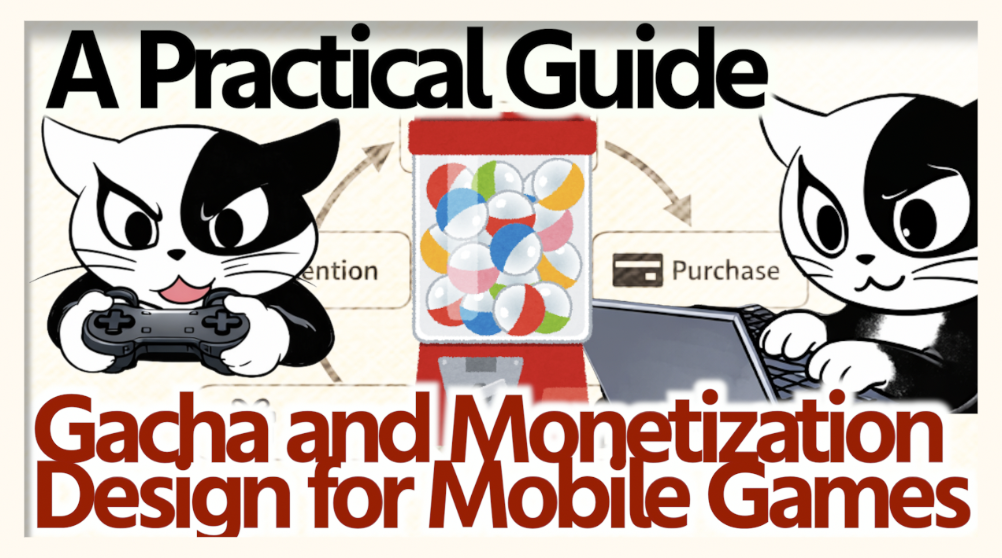
A Practical Guide to Gacha Design and Monetization Design for Mobile Games

Hello, this is Toroneko.
Even today, “gacha” still accounts for a large share of mobile game revenue.
But that does not mean revenue will grow just because you implement a gacha system.
・What makes users want to pull gacha?
・From the start of the game, through what process do you guide users toward gacha?
・Which gacha is supposed to generate revenue?
These things need to be designed in the right order.
So in this article, I will explain how monetization design for “gacha-based games” should be built, in what order, and what you should be thinking about along the way.
Of course, you do not have to adopt everything written here as-is.
However, simply understanding the basic way of thinking behind gacha implementation can significantly improve the precision of your monetization design.
Please use this as a reference before designing gacha monetization for your mobile game.
What You Should Not Do in Monetization Design

When people start talking about monetization design, many immediately want to begin with “how to sell.”
But this is a major mistake.
What you need to confirm first is not monetization, but the “core gameplay experience.”
・When playing the game, what feels good?
・What makes players want to keep playing again and again?
・Is the intended fun of the game actually working as designed?
If you start thinking about monetization before this part is clear, the game will easily become too monetization-heavy.
In other words, it becomes easier to end up with a design that tries to force monetization through gacha presentation and live operations, giving users an impression close to “hard selling.”
For users, “paying” is only the result of playing the game.
That means the main character is the “game” itself, and monetization happens after the game proves enjoyable.
And gacha is not what determines whether the game itself is fun.
At most, it is something like an “accelerator” that lets players enjoy the game experience more.
So the order
“Confirm the game’s fun first” → “Then design monetization”
is extremely important.
I wrote about core gameplay experience in more detail here.
How to Design Gacha in Game Development
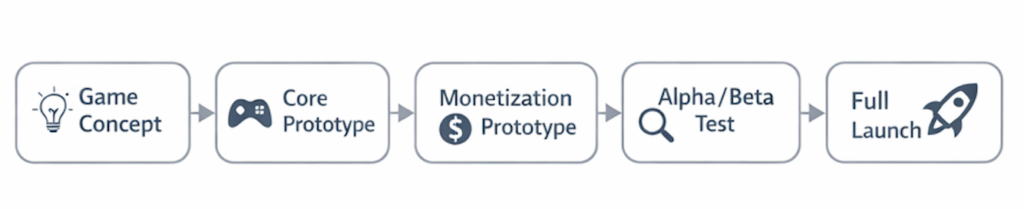
For mobile game gacha monetization, I recommend thinking in the following order.
↓
② Prototype (confirm the core gameplay experience)
↓
③ Monetization prototype design
↓
④ Verify monetization flow from alpha onward
↓
⑤ Finalize specs and fully implement
Steps ① and ② are part of normal game development, but monetization design should only begin after step ②, once the game’s core fun has been confirmed through the prototype.
Why?
Because gacha does not determine whether the game itself is fun.
It is only something like an “accelerator” that lets players enjoy the game experience more.
Only after the core gameplay experience is working should monetization design be built on top of it.
I call this “monetization prototype design.”
Common bad cases include:
・Monetization is given more weight than the game concept itself
・Monetization design is pushed forward by schedule pressure before the prototype has actually confirmed the core gameplay experience
These situations are seen quite often.
The reason this way of thinking appears in actual development is because people start assuming:
“We just need to add a gacha.”
“Live operations can fix it later.”
“We can monetize through techniques like limited banners, step-up banners, and guaranteed banners.”
That way of thinking shows that they do not understand the process users go through before pulling gacha.
This kind of thinking is proof that you do not understand the process users go through before they pull gacha.
In reality, users go through a process before they decide to pull gacha.
・There must be a “trigger” inside the play experience that makes them want to pull just a little
・There must be a feeling that the pulls are not wasted
・There must be a reason to keep pulling, instead of stopping after just one try
If you implement without understanding this process, it will not work well.
That is why, before implementation, you need to understand “monetization prototype design.”
What to Decide First in Monetization Prototype Design
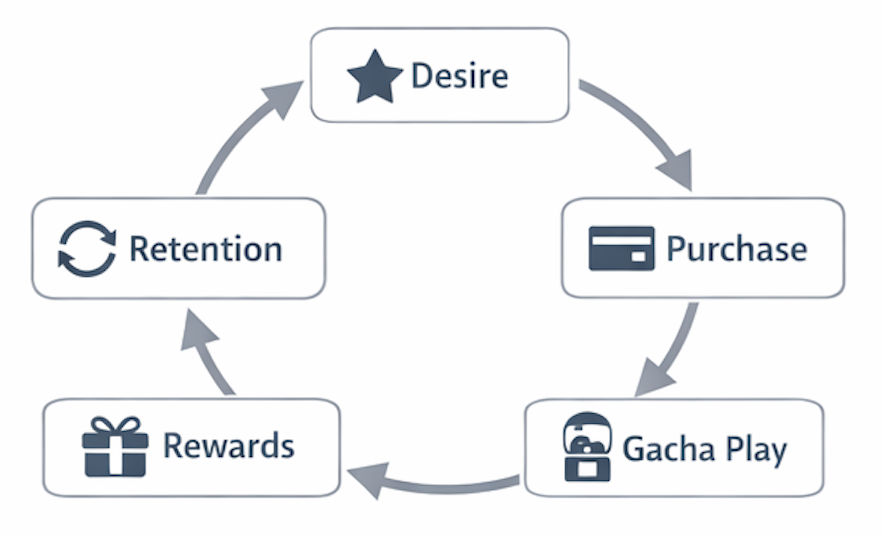
“Monetization prototype design” means designing monetization while taking into account the process users go through after experiencing the core gameplay and before reaching the point of payment, and then testing whether users actually behave the way the design expects them to.
“Monetization prototype design” consists of the following four elements.
② The reasons users pull gacha
③ The reasons users want to keep pulling gacha
④ Techniques that support gacha conversion
① The Process Until the User Pays
A basic process leading to payment often looks like this:
↓
・The game feels fun (evaluation of the core gameplay experience)
↓
・Want to progress further
↓
・Different motives appear, such as wanting to get stronger, win, or show off
↓
・Make a purchase
This process varies from user to user.
In practice, it differs depending on user attributes such as past game experience and preferences.
Some users go through this process almost instantly, while others take more time. So of course it will differ depending on your title, but as a rough basic model, this is a useful flow to understand.
From there, gacha design should be thought about not as “points,” but as a “line.” In other words, not as isolated elements, but as a flow.
└ Reasons vary by game: power, presentation, motif, limited status, etc.
↓
・Pull a little
└ There needs to be an entry point for the first pull
└ Free currency, first-time bonuses, etc.
↓
・Pay to pull
└ Cross the first small payment barrier
↓
・Pull regularly (build a habit)
└ Subscription pass, login rewards
↓
・Feel the value of pulling (be convinced internally)
↓
・The process becomes visible
└ How many pulls until guarantee?
└ How far along am I now?
↓
・Misses do not feel wasted
└ Even duplicates, low-rarity pulls, and “bad” outcomes need some value
└ If they feel wasteful, users stop there
↓
・Pull again next time
└ Satisfaction with the gacha experience
↓
・Pull until pity
└ Make the remaining distance to pity visible
Of course, not every user will pull all the way to pity.
However, understanding this process makes “monetization prototype design” much easier.
Also, when this flow connects continuously, it becomes easier for revenue to accumulate.
On the other hand, if the design is weak at any point, users stop halfway.
In short,
designing a flow that makes pulling gacha feel natural and habitual
is important.
Subscription Passes Are Effective as the Entry Point for Habit Formation
A “subscription pass” implemented in the game can work as the entry point for
“designing a flow that makes pulling gacha feel natural and habitual.”
In general, subscription passes are often implemented for purposes like these:
・Maintaining retention and reducing churn by keeping core fans engaged
But in reality, they have an even bigger role. That is:
To get users over the first small payment barrier.
The experience of pulling gacha with free currency gained as a fully free player,
and the experience of pulling gacha with currency gained through a low-cost subscription pass,
may look similar, but they are actually different.
In the case of a subscription pass, the user has already paid money.
That lowers the psychological barrier to moving on to further “gacha spending.”
So the real value of a subscription pass is:
・Giving them a reason to log in every day
・Creating the habit of pulling gacha with the currency gained from subscription rewards
・As a result, leading them beyond subscription rewards into paid gacha behavior
That is where the real value lies.
Will you implement and operate a subscription pass simply as a way to secure stable revenue?
Or will you design it while considering habit formation that leads into paid gacha?
That difference in thinking has a major effect on revenue.
② Why Users Pull Gacha
Why do users pull gacha?
Understanding this makes “monetization prototype design” even more precise.
There is not just one reason users pull gacha.
And those reasons also change depending on the game genre.
Typical motives include the following:
・They want it because they need it now
If a new character or new equipment lets them power up,
wanting to progress further,
wanting to win in PvP or PvE,
or wanting a solution because they are stuck or losing,
all become strong motives for pulling gacha.
・They want it because it will be useful later
Even if the need is not high right now, it may have strong future value for upcoming events, quests, or long-term progression plans.
That creates a motive to secure it in advance.
・They want it because it is attractive
For example:
special moves, animation, voice, effects, coolness, cuteness.
Visual appeal, “oshi” appeal, and IP appeal all become motives for pulling gacha.
This also works on users who are not moved by specs or performance alone.
・They want it because it is limited
It is not always available, and can only be obtained now.
That sense of “limited availability” is also one of the reasons users pull gacha.
・They want it out of self-expression or comparison
Other players have it.
They do not want to lose to other players.
They want to have it for guilds, alliances, friends, rankings, or PvP.
“Showing off” and “competitive awareness” also become motives.
The same applies in avatar-based games, where players pull gacha because they want that outfit, that accessory, or that look.
・They want it after actually using it
They used a character through a friend system or rental feature, and it felt strong, useful, or fun.
That kind of experience also becomes a motive for pulling gacha.
On top of that, the two important points are these:
・These desires only work when they are built on top of a core gameplay experience
→ They do not work without core gameplay
・The reasons for pulling differ depending on the user type and the game itself
→ Not all motives exist at the same level. You need to decide which one is the central driver
That means the big premise is that the “core gameplay experience” has already been properly built and validated.
I wrote about core gameplay experience in more detail here.
③ Why Users Want to Keep Pulling Gacha
Gacha does not become revenue if users only pull once.
So you also need to design around the reasons users want to keep pulling.
・A design where duplicate pulls are not wasted
One major reason gacha becomes a one-time action is that the game does not properly handle “bad pulls” that the player does not need.
For example, this often happens:
・A duplicate character appears, but it only becomes merge material
・A low-rarity pull appears, but it has no meaningful use
That makes players feel like pulling gacha was a loss.
So, when creating reasons for users to keep pulling,
what matters is giving duplicate pulls and low-rarity pulls some other form of value.
For example:
・They can be converted into special currency
・They can be exchanged for something else in a shop
・They can be used for skill upgrades or special unlocks
These are examples.
The key point is:
a “miss” should not feel wasted,
and the miss experience should not end only in disappointment.
If you account for this, users are less likely to feel
“all my pulls were completely wasted.”
As a result, it becomes less likely that their reason to keep pulling will be blocked.
・Making pity and progress visible
People feel anxiety when they cannot see the “goal” or “destination.”
The same is true for gacha, so what matters for getting users to keep pulling is making progress visible.
How far along am I now?
Which step of the step-up banner am I on?
What is guaranteed next?
By making pity and progress visible like this, users can understand where they currently stand.
As a result:
“10 more pulls until guarantee”
“5★ guaranteed on the next step”
“I’ve come this far, so I want to continue”
These feelings become motivation to keep pulling gacha.
・Do not make the user hesitate
Some games prepare a large number of gacha products.
↓
More complete product lineup
↓
Higher user satisfaction
That is one way to think about it.
But at the same time, there is also the possibility that this simply makes the user hesitate.
What matters is: what is actually supporting revenue in this game?
In reality, it is rare for multiple gacha banners to sell evenly.
More often, one core gacha concentrates most of the revenue.
That means it is important not to simply leave the choice to users,
but to make clear which gacha the design intends users to pull.
If that part is vague:
・The real sales target becomes blurred
・The gacha funnel stops functioning
・User response weakens and revenue does not grow
That kind of situation becomes more likely.
So the first thing you need to decide is:
“Which gacha in this game is supposed to generate revenue?”
④ Techniques That Support Gacha Conversion
Gacha conversion can also be supported through game operations and presentation.
For example:
・Step-up banners
・Guaranteed 5★
・Revival banners
・Banner messaging
・Event tie-ins
・Recommended display
These kinds of techniques can push users toward spending.
However, this only comes
after “core gameplay” and “monetization prototype design” are already in place.
If those are missing, and you try to solve everything only through operations and presentation,
you create the impression of “high monetization pressure” and “hard selling” toward the user.
And even if it creates short-term revenue, it will not produce stable long-term revenue, and it will damage user trust.
To summarize:
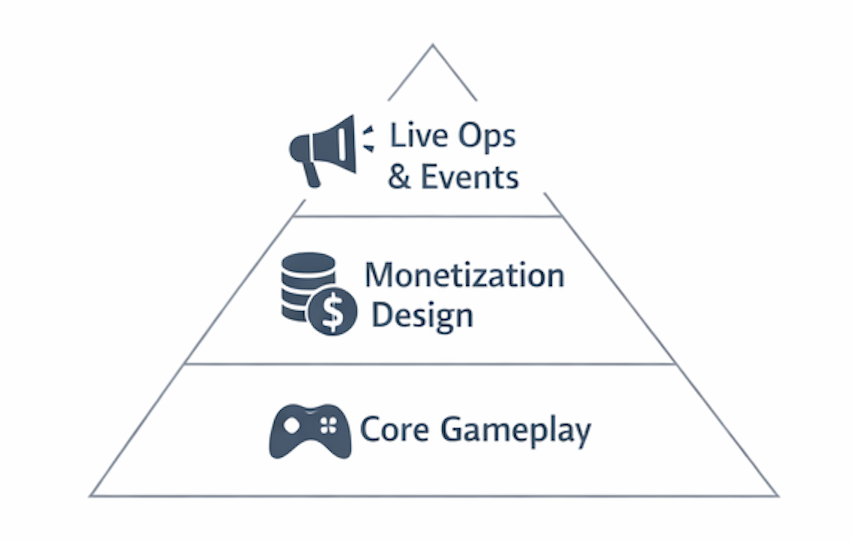
・On top of that comes “monetization prototype design”
・Game operations, presentation, and banner treatment are only supporting elements
If this relationship gets reversed, things stop working.
What Is Monetization Design That Does Not Feel Like Hard Selling?
In “monetization prototype design,” the goal is not just to create revenue.
The important point is getting users to make a purchase with a sense of acceptance.
・The problem is “monetization pressure” and “hard selling” without a sense of acceptance
That is the key point.
For example, the following approaches can easily make users feel “monetization pressure” or “hard selling”:
・The game balance is suddenly changed around paid elements
・It is presented as if not paying now will hurt future play
・Bad gacha results become a pure loss
・The goal and progress of gacha are not visible
・It is unclear what users are actually getting in return for paying
These kinds of designs create a “hard selling” impression for users.
On the other hand, the following approaches can reduce that feeling:
・The goal and progress of gacha are visible
・Bad pulls do not feel wasted
・The value of the characters or items obtained through payment is clear
・The game remains playable long term without breaking balance
Gacha is not the “fun” of the game itself.
It is there to expand the “core gameplay experience,” broaden the fun, and accelerate it.
Gacha is not the main character.
This may sound obvious,
but in reality, development and operations teams often lose sight of this, so it is something to watch carefully.
Checklist Before Implementing Gacha
Finally, here is a summary of the minimum points you should confirm before implementing gacha and monetization functions.
Please use it as a checklist.
① Is the core gameplay experience actually working?
→ Are you moving into monetization design while the fun is still weak?
② Is the core revenue-driving gacha decided?
→ Is it still vague which gacha is actually supposed to sell?
③ Is the reason to pull that gacha clear?
→ Are there real reasons to pull, such as performance, presentation, character appeal, competition, or ownership?
④ Is there a funnel and process that leads users into the first pull?
→ Entry points such as free trials, small payments, subscription passes, etc.
⑤ Is the flow of pulling gacha connected as a “line,” not just as separate “points”?
・Want it
↓
・Pull a little
↓
・Pay to pull
↓
・Pull regularly (habit)
↓
・Feel the value of pulling (acceptance)
↓
・The process becomes visible
↓
・Misses do not feel wasted
↓
・Pull again next time
↓
・Pull until pity
⑥ Do duplicate pulls and bad pulls have some other value?
→ Are they not just losses? Is there another use for them?
⑦ Is the presentation of pity and progress good enough?
→ Is the goal clearly visible?
⑧ Are you trying to solve things only through operations or gacha presentation?
→ Have you actually done “monetization prototype design”?
Summary

Mobile game gacha monetization design is not simply a matter of implementing a gacha function.
What matters is “monetization prototype design,” built not as isolated “points,” but as a connected “line.”
・Confirm the core gameplay experience
・Design the monetization prototype
・Only after that, support gacha conversion through live operations, presentation, and banner treatment
Even just following this order can greatly improve the precision of monetization design.
Toroneko can support not only this gacha topic, but also the overall process around game business.
If you are unsure about your direction, feel free to reach out.