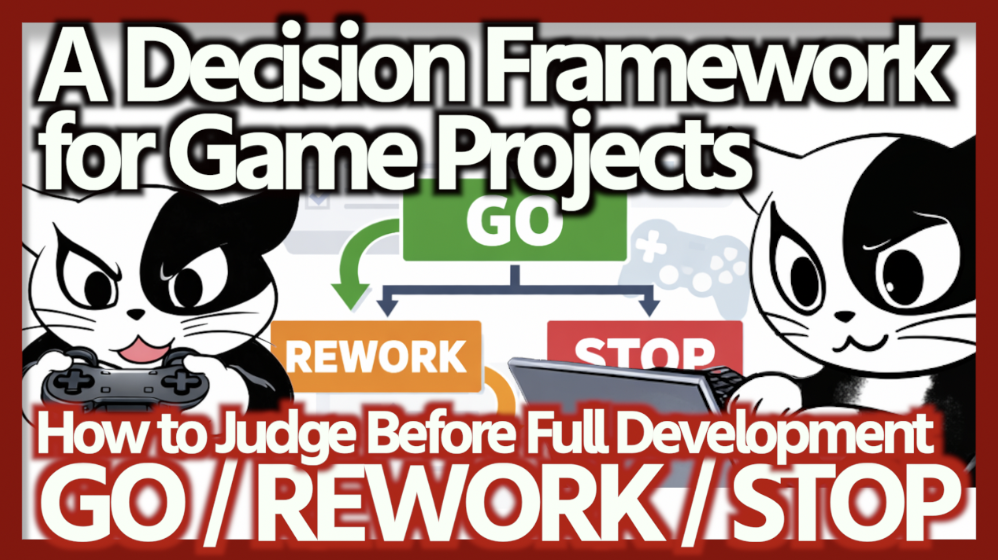
- A Decision Framework for Game Projects | How to Judge GO, REWORK, or STOP Before Full Development
- The Purpose of This Manual (Article)
- The Core Reason Game Businesses Fail Is That They Cannot Stop the Concepts They Should Stop
- Why the Decision to Stop Should Be Defined Before the Decision to Proceed
- The Two Most Important Gates in This Manual
- The Single Most Important Thing to Judge at the Concept Stage Is the Core Gameplay Experience
- Judgment Criteria to Check at the Concept Gate
- ① Is There a Market?
- ② Is It Clear Who You Are Selling To?
- ③ Is There a Real Chance Against Competitor Titles?
- ④ Can It Work Within Your Company’s Budget and Development Structure?
- ⑤ Does It Have the Potential to Reach the Company’s Required Return Line (Business Scale)?
- ⑥ Is the Core Gameplay Experience Clearly Defined?
- ⑦ Is It a Concept That Tries to Invent Game Fun from Zero?
- ⑧ Does It Have Originality?
- Judgment Criteria to Check at the Prototype Gate
- A Common Failure: Rebuilding the Core Gameplay Experience After the Prototype
- GO / REWORK / STOP Criteria
- A Company That Can Stop at the Prototype Stage Is Strong
- Why Game Companies Cannot Narrow Down Concepts Strictly Enough
- The Value of Bringing in Toroneko
- A Concept Judgment Sheet That Can Be Used in Approval Meetings
- Summary
A Decision Framework for Game Projects | How to Judge GO, REWORK, or STOP Before Full Development
A game business does not fail only because it cannot create a “fun concept.”
The real cause is this:
“Development moves forward while the standards for judging project progress, and the stage at which it should be stopped, remain unclear.”
This is the biggest reason.
What is especially dangerous is
“moving forward without identifying the core gameplay experience through a prototype.”
If development continues in this state, the team may later discover—often in the middle or later stages of production—that the core gameplay experience (= the base game system of this title) must be rebuilt, causing both time and money to be lost.
And in cases like this, where the core gameplay experience is rebuilt late, the game often ends up being completed with that core still vague, and the project does not succeed as a game business.
They understand the importance of the “core gameplay experience” that should be judged at the prototype stage, but in reality they still cannot make the decision to stop the project midway.
Why?
“Because internal influence, business plans, responsibility avoidance, and an atmosphere that does not want conflict all weaken judgment.”
This article is a practical manual that summarizes what should be checked and how decisions should be made at the concept stage and the prototype stage, in order to reduce those failures.
And this manual is a way of thinking that can be used regardless of development scale—whether for solo development, indie teams, small and mid-sized game companies, or large game companies.
The Purpose of This Manual (Article)

This manual (article) is not a summary of game concept ideas or brainstorming methods.
It is a set of criteria for deciding whether a game concept and its development should be allowed to move forward as they are.
It offers benefits for both the development side and the management side.
For the management side, it becomes a decision axis for preventing failure in the game business.
And this manual has one purpose only:
To enable the development side and the management side to review a game concept and prototype using the same standards, and to move forward only with projects both sides can agree on.
The Core Reason Game Businesses Fail Is That They Cannot Stop the Concepts They Should Stop
A game business does not fail only because of weak concept ability or weak development ability.

A common problem is that the criteria for approving a concept are vague, and the criteria for stopping a project are even more vague, yet the project still moves forward.
As a result, projects sometimes move forward not because “the game concept is fun,” but because of internal circumstances or who has more influence.
Sometimes projects even move into full development without confirming the core gameplay experience at an early stage.
In game development, costs increase as the process advances.
And it becomes harder to stop the project.
Then, by continuing all the way to launch or release with weak prospects, the company loses time, money, trust, and development resources.
At its core, the real issue is being unable to stop the concepts that should be stopped.
This is the essence of why game businesses fail.
Why the Decision to Stop Should Be Defined Before the Decision to Proceed

Many game companies place importance on the decision to proceed (= the decision to develop).
But in reality, the decision to stop is more important.
The reason is simple.
The further development goes, the larger the company’s loss becomes.
The fact that development has already advanced this far is not, by itself, a reason to keep developing.
That is only the emotion of wanting to recover sunk cost or not wanting to waste what has already been spent.
It is not a sound business decision.
This is where the prototype becomes important.
If a project can be stopped at the prototype stage, where the core gameplay experience (the game’s fun) can be verified, the company can keep losses much smaller.
The difference in loss compared with stopping near completion or near master build is enormous.
Also, stopping a project early is not a defensive move. In fact, it is an offensive move.
Because by stopping a project at this stage,
・Resources can be shifted to the next concept
・The number of chances to challenge new concepts can be increased
As a result, it becomes possible to find concepts among a huge number of game ideas that actually have a chance to succeed.
The Two Most Important Gates in This Manual
The most important parts of this manual are the “Concept Gate” and the “Prototype Gate.” Of course, the steps after the prototype also matter, but the business potential is largely decided at these two gates.
Concept Gate
At the initial game concept stage, the business potential is almost already decided.
At this point, you check the market, competitors, target users, core gameplay experience, and business potential.
If the concept lacks precision at this stage, then even if you later try to rescue it with advertising, live operations, or monetization after development, improvement remains difficult because the base fun of the game is weak.
Prototype Gate
A concept judged to have potential on paper is then actually built and moved in order to verify the “core gameplay experience.” That is the prototype.
The prototype is review material for verifying the “core fun of the game.”
So if you do not define what must be checked in the prototype, you cannot make a proper judgment.
A common thing seen during prototype review is this:

“We could not include enough of the core gameplay experience in the prototype.”
“Please judge it after seeing the next alpha version.”
There are cases like this, and the decision on the project gets postponed.
But in many such cases, people later regret it and conclude it was a mistake.
Why?
“A concept or development team that cannot even complete the prototype will not be able to complete full development either.”
“In the end, the final product will be completed with the core gameplay experience still vague.”
These are things that are often seen in real development environments.
That is exactly why management must judge the prototype strictly
and reject the project if necessary.
The Single Most Important Thing to Judge at the Concept Stage Is the Core Gameplay Experience

Here, “core gameplay experience” means the central kind of play that makes users want to keep playing this game repeatedly. In other words, it is the core part that supports the game’s fun.
The single most important thing to judge at the concept stage is the core gameplay experience.
Why?
Because the core gameplay experience is “the backbone of this game’s fun,”
and it creates the foundation of the “motivation to keep playing” through repetition.
In the end, the core gameplay experience leads to
・DAU
・A reason to play this game
These are all critical things.
In other words, without a core gameplay experience, the reason to play this game—and to keep playing it—becomes weak.
Of course, “live operations” and “monetization” are also important.
However, their priority as judgment criteria is lower than the core gameplay experience.
Why?
Because operations and monetization are areas that are easier to adjust later.
There are repeatable “systems” for them, and there is still room to tune them after the prototype stage.
But the core gameplay experience is different.
There are cases where development continues while the core gameplay experience remains weak, and later the team has to rebuild from the middle of development. This not only wastes money and time, but also leads to a final game that lacks consistency and coherence.
That is why it must be judged strictly and carefully at the prototype stage.
Judgment Criteria to Check at the Concept Gate
The Concept Gate is the phase where you decide whether this concept has enough value to move forward as a business.
At the Concept Gate, you review multiple items, but among them, the core gameplay experience should carry the most weight.
Even if marketability and competitor analysis are good, if the core gameplay experience is weak, the project will still be difficult as a game business.
Below is an explanation of the criteria to check at the game concept stage.
When a new game concept appears, this is where you decide whether to “move forward” or “stop.”
① Is There a Market?
Check whether there is a market you can actually target with that genre and concept.
・Is the market size large enough for the business to work?
・Is the market too small to begin with?
・Is there still a real chance to win if entering now?
・Is there a meaningful reason to do it?
Game genre × game concept
With this combination, you can estimate market size.
You need to judge calmly whether that market is large enough to support the business.
Of course, if there is no market, you cannot move forward. But even if there is a market, if competition is too intense, reconsideration is still necessary.
② Is It Clear Who You Are Selling To?
Can you clearly describe the people who need this concept, the people who will play it, and the people who are likely to play it?
Can you clearly imagine the target user as a real person?
That is what should be judged here.
・What part of this concept will attract that person?
・What about this game will make that person feel it is worth playing?
Even if a market exists, if the target user is vague
or if the game itself does not reflect the target user properly, it will not work.
③ Is There a Real Chance Against Competitor Titles?
The game business is already mature.
It is no longer about opening entirely new territory.
It is about competing for a limited pool of players.
So if your new game becomes a hit,
that means it will take discretionary time and discretionary spending away from users who are already playing other games.
That is why
“Is there a real chance against competing titles?”
is extremely important.
Here, “competitor titles” means the games competing for the same users as your new concept.
So games become competitors when their genre, concept, and target users overlap with yours.
・What are those competitor titles being praised for in terms of “game fun”?
・Compared with competitor titles, can you explain why users would choose your title?
The game business is competition for a limited pool of players.
So you cannot move forward while your research on competitor titles remains shallow.
④ Can It Work Within Your Company’s Budget and Development Structure?
No matter how attractive a concept is, and even if it seems to have a chance against competitors,
if you cannot actually develop and operate it, then it is only a desk fantasy.
In fact, many game companies are seen making project decisions while this part is missing.
・Can your in-house development team deliver the required quality? (Is it a genre where your strengths can be used?)
・Can the company carry it through not only in development, but also in live operations afterward?
Even if a concept sounds fun, it is dangerous to move forward as a business if it does not fit your company’s real environment.
In other words, what needs to be checked is:
“Is it not just something we want to make, but something we can actually finish?”
“And on top of that, is it worth investing in as a business?”
⑤ Does It Have the Potential to Reach the Company’s Required Return Line (Business Scale)?
This is a business, so even at the concept stage, the project’s potential should be judged from an investment point of view.
Some game companies say:
“At the concept stage, business perspective is unnecessary. The goal is simply to produce fun ideas.”
But if this phase becomes only “just game ideas,”
then later someone has to pull those ideas up to a real business level.
As a result, many studios end up letting low-business-potential concepts move all the way into full development and launch, so I do not recommend that approach.
・How high is the investment risk? Is it within an acceptable range?
・Is there a reason to prioritize this concept over others?
Even if a concept sounds fun, you cannot proceed if it does not work as a business.
It must be judged based on whether it works as a business.
This is not a place for emotion. It should be judged calmly by business conditions.
⑥ Is the Core Gameplay Experience Clearly Defined?
What matters at the concept stage is not the world setting, characters, progression features, effects, or small functions.
What matters is the “core gameplay experience.”
・In a puzzle game, the core gameplay experience of matching pieces
・In an action game, the core gameplay experience of controlling the character
The core gameplay experience can be defined differently depending on the concept,
but in one phrase, it is:
“the base engine that makes users keep playing this game repeatedly.”
“the fundamental way of playing that stays enjoyable even after repeated play.”
・Does the core gameplay experience contain what is needed to support the motivation to keep playing without getting bored?
That is what should be checked here.
There are also game concepts that try to make a game look attractive through worldbuilding, characters, and various functions because the core gameplay experience has not been developed deeply and remains vague.
Those need to be judged carefully.
⑦ Is It a Concept That Tries to Invent Game Fun from Zero?
This is one of the common reasons game concepts fail.
“Trying to invent game fun completely from zero.”
In the modern era, inventing a completely new kind of game that has never existed before is close to a miracle.
“Most hit games are based in some way on existing games,
and it is fair to say there are almost no game concepts that were truly invented from nothing.”
Even if you did invent something never seen before,
users would often fail to understand it quickly enough, so it would not work well as a game business.
Games that users cannot quickly understand
are difficult for users to choose to play in the first place.
It is important to study hit games and competitor titles deeply,
understand what they do well and where they are weak,
and reflect that into your own concept.
⑧ Does It Have Originality?
However, simply copying existing games also will not work.
Why?
Because games that feel overly familiar do not strongly motivate users to start playing.
So what matters here is:
“Do not try to invent game fun from zero.”
“Study hit games and competitor titles deeply.”
“Create a concept with a core gameplay experience that feels fun within the range users can understand.”
And then, on top of that:
“Add one original element to the core gameplay experience that is unique to your game—two at most.”
“Use that to remove the feeling of familiarity and differentiate against competitor titles.”
In other words:
Does this concept really contain originality that belongs to this game?
That is what needs to be checked calmly.
Judgment Criteria to Check at the Prototype Gate
The Prototype Gate is the phase where you verify the core gameplay experience and the team’s ability to execute by using an actual build.
Once the game concept passes, the next step is to develop a prototype.
The definition of a prototype is this:
It is the process of actually building and moving the “core gameplay experience” described in the concept in order to verify whether it is fun.
Something can look fun on paper,
but whether it is actually fun when played is a different matter.
The points to verify in the prototype are as follows.
① Can the Core Gameplay Experience Be Verified?
・Can the game’s fun be verified through a playable build?
・As a result, does it make players want to keep playing repeatedly?
If this cannot be confirmed in the prototype, then the project cannot move into full development.
Because the core gameplay experience ultimately leads to
・DAU
・A reason to play this game
These are critical things.
In other words, if the core gameplay experience cannot be confirmed, then the reasons to play—and to keep playing—become weak. As a result, this affects player motivation after release.
② Are the Prototype Review Points Defined?
When using the prototype to verify the core gameplay experience, if the review points are not defined,
the decision ends up being made only by vague feeling.
That is why judgment must be made after review points have been clearly defined.
・Controls / feel
・Process
・Play cycle
・Tempo
・The satisfaction of clearing or winning
・Motivation to continue
For example, a prototype can be evaluated with points like these.
If the review criteria are vague, the evaluation will also become vague.
You must not give GO in that condition.
③ Can It Realistically Be Developed?
Even if the finished prototype includes the core gameplay experience
and the result is fun and satisfying,
the following points still need to be judged calmly:
・Are there enough resources to operate the completed game?
・Can the company tolerate it as a business?
・Can it realistically generate a business return?
These points must be judged calmly again.
The goal is not to make a prototype.
The goal is for the project to succeed as a business in the end.
Once the project goes beyond the prototype stage, company spending rises sharply, so in addition to the concept and prototype themselves, the team’s execution ability and business profitability must also be checked.
④ Is There Enough Evidence to Move Into Full Development?
A common thing at the prototype stage is this:
“We could not fully include the game’s core gameplay experience in the prototype.”
“Please judge it after the next alpha version.”
This kind of case means the prototype does not meet the actual prototype requirements,
but is still allowed to pass as if it did.
There are two important points here:
・There are concerns about trusting a development structure that cannot even finish the prototype properly
In real development settings, there are many cases where companies still let this pass because of internal circumstances.
But in reality:
“A concept or development team that cannot even complete the prototype will not be able to complete full development either.”
“In the end, the final product will be completed with the core gameplay experience still vague.”
These things are seen very often in real projects.
As a result, the game business fails.
That is exactly why management must judge the prototype strictly
and either require the prototype to be redone, or reject the project itself.
The prototype is the place to confirm whether there is truly enough evidence to move into full development.
A Common Failure: Rebuilding the Core Gameplay Experience After the Prototype
A common failure is moving forward even though the core gameplay experience could not be confirmed in the prototype.
As a result, the team later has to redesign the core gameplay experience and the central parts of the game that support it.
That leads to:
・Higher costs and a longer schedule
・A much higher risk that the final game ends up broken in terms of actual fun
Game development builds the world setting, characters, story, effects, various assets, and live operations on top of the core gameplay experience.
When the core gameplay experience changes, the rest of the parts stop fitting together.
So if the core gameplay experience cannot be confirmed in the prototype, you must not give GO at that point.
If this part is left vague, it becomes very difficult to recover later.
GO / REWORK / STOP Criteria

GO / REWORK / STOP are the three categories used to judge whether a game concept or development should move forward as-is, be revised and resubmitted, or be stopped here.
They can be used for both the game concept stage and the prototype stage.
Here I will explain the criteria for each.
GO
・The major conditions are satisfied.
・The development side and management side can agree.
・There is a clear reason to move forward as a business.
・The core gameplay experience has been confirmed.
If the project is in this state, it is GO.
REWORK
・The direction is correct.
・There is potential.
・However, there is still an issue somewhere in “market,” “competition,” “differentiation,” “team structure,” “profitability,” or “prototype quality.”
It is not at the level of rejection.
There is still potential as a game, but there are issues that make it unsafe to move forward as-is, so it should be revised and resubmitted.
STOP
・Agreement cannot be reached.
・Even with revision, the outlook is weak.
・There is no business reason to move forward.
In that case, it should be STOP.
In fact, STOP is not a negative action.
Rather, stopping here is a healthy business decision because it allows resources to be moved to the next concept.
This is a positive decision for both management and development.
Why?
Because the more a project lacks potential and is likely to fail,
the more money and time the company loses,
and the more development time is wasted on it.
For example, if a game that took three years to develop is shut down only one year after release,
the money and time lost are enormous.
Money can be earned back.
Time cannot.
A Company That Can Stop at the Prototype Stage Is Strong
If a project is stopped at the prototype stage, losses can be kept small.
If it is stopped near the master build, the loss is enormous.
In other words:
・How effectively can you stop game concepts at the prototype stage?
・Can you identify game concepts that have a high chance of success at the prototype stage?
That is the key to avoiding failure in the game business.
And by stopping at the prototype stage, you create room to try another game concept.
How well can you find game concepts that truly have business potential?
That is what matters.
Why Game Companies Cannot Narrow Down Concepts Strictly Enough
In many companies, game concepts are not being chosen from among 100 ideas through strict selection.
In other words:
“There are far too few GO / REWORK / STOP decisions at the concept and prototype stages.”
・Cases where a concept that happened to be proposed is simply developed as-is
・Cases where the concept of someone with stronger influence passes more easily
・Cases where there are no other concepts available
There are many such cases.
And above all:
Executives may be able to judge business potential, but that does not mean they can judge games.
And on the development side, there are also cases where the goal becomes “making a game” rather than “making money for the company.”
The key point here is:
“This is not about someone being bad. It is that each side is looking at the project through different standards.”
That is exactly why a shared decision guideline is needed.
The Value of Bringing in Toroneko
Toroneko is not on the side of management, and not on the side of development either.
Toroneko acts as a third party who can make judgments without being bound by internal politics or human relationships.
・At the same time, I can also help prevent truly valuable game concepts from being rejected because of weak evaluation ability.
In other words, the goal is to support decisions that make the people involved in that game company better off as a whole.
For example,
I can help organize decision criteria before the concept meeting, design prototype review items, and refine the one-sheet used in approval meetings.
A Concept Judgment Sheet That Can Be Used in Approval Meetings
Finally, based on everything above, I have put together a draft judgment sheet that can be used in approval meetings.
It is only a draft, so it still needs to be adjusted to fit your company’s situation and the characteristics of your title.
Company size, strong genres, budget, required return line, acceptable risk, and what needs to be verified in the prototype all differ from company to company.
Even with the same items, the weighting changes by company, so if you want a guideline that actually works, it must be redesigned for your own organization.
Game Concept Judgment Sheet (for Approval Meetings)
Concept Overview
・Concept name
・Planned genre
・Planned platform
・Planned target user
・Development scale
・Planned release timing
Marketability
・How many users are likely to play it?
・Is the market size large enough for the business to work?
・Is the market too small to begin with?
・Is there still a real chance to win if entering now?
・Is there a meaningful reason to do it?
Evaluation: GO / REWORK / STOP
Target
・Who is the target user?
・What part of this concept will attract that person?
・What about this game will make that person feel it is worth playing?
Evaluation: GO / REWORK / STOP
Competition / Winning Angle
・Which competitor titles are already selling?
・What are those competitor titles being praised for in terms of “game fun”?
・Compared with competitor titles, can you explain why users would choose your title?
Evaluation: GO / REWORK / STOP
Fit with the Company’s Budget and Development Structure
・Given the budget and development resources, can it actually be completed?
・Can your in-house development team deliver the required quality? (Is it a genre where your strengths can be used?)
・Can the company carry it through not only in development, but also in live operations afterward?
Evaluation: GO / REWORK / STOP
Business Potential
・Does it have the potential to reach the return level the company expects?
・How high is the investment risk?
・Is there a reason to prioritize this concept over others?
Evaluation: GO / REWORK / STOP
Core Gameplay Experience [Most Important]
・Can you explain this game’s core gameplay experience (its fun) in one sentence?
・Does the core gameplay experience contain what is needed to support the motivation to keep playing without getting bored?
Evaluation: GO / REWORK / STOP
Originality
・Does it feel overly familiar?
・Is there one valuable point of differentiation, at most two?
Evaluation: GO / REWORK / STOP
Overall Judgment
・Overall evaluation: GO / REWORK / STOP
・Main reasons
・Points to revise
・Resubmission deadline
・Next judgment date
Comment Section
・Development-side comment
・Business owner comment
・Management-side comment
I also turned it into a table.
| Item | What to Check | Evaluation |
|---|---|---|
| Concept Overview | Concept name
Planned genre Planned platform Planned target user Development scale Planned release timing |
|
| Marketability | How many users are likely to play it? Is the market size large enough for the business to work?
Is the market too small to begin with? Is there still a real chance to win if entering now? Is there a meaningful reason to do it? |
GO / REWORK / STOP |
| Target | Who is the target user?
What part of this concept will attract that person? What about this game will make that person feel it is worth playing? |
GO / REWORK / STOP |
| Competition / Winning Angle | Which competitor titles are already selling?
What are those competitor titles being praised for in terms of “game fun”? Compared with competitor titles, can you explain why users would choose your title? |
GO / REWORK / STOP |
| Fit with the Company’s Budget and Development Structure | Given the budget and development resources, can it actually be completed?
Can your in-house development team deliver the required quality? Can the company carry it through not only in development, but also in live operations afterward? |
GO / REWORK / STOP |
| Business Potential | Does it have the potential to reach the return level the company expects?
How high is the investment risk? Is there a reason to prioritize this concept over others? |
GO / REWORK / STOP |
| Core Gameplay Experience [Most Important] | Can you explain this game’s core gameplay experience (its fun) in one sentence?
Does the core gameplay experience contain what is needed to support the motivation to keep playing without getting bored? |
GO / REWORK / STOP |
| Originality | Does it feel overly familiar?
Is there one valuable point of differentiation, at most two? |
GO / REWORK / STOP |
| Overall Judgment | Overall evaluation
Main reasons Points to revise Resubmission deadline Next judgment date |
GO / REWORK / STOP |
| Comment Section | Development-side comment
Business owner comment Management-side comment |
Summary

What matters in game business is not only the decision to proceed.
It is also crucial to judge strictly at the Concept Gate and the Prototype Gate.
Especially, the core gameplay experience is the single most important decision axis.
If that cannot be confirmed in the prototype, the project should not move forward.
To do that,
you need to define, as your company’s own standard, what should be checked at each stage, what level allows the project to proceed, and what level requires it to stop.
Even among game companies, the required return line, acceptable risk, and what should be checked in the prototype all differ.
So judgment guidelines and judgment sheets do not work simply by being copied as-is.
At Toroneko, I adjust concept review criteria, prototype review criteria, and the judgment sheet used in approval meetings to match your company’s situation and the characteristics of your title, and turn them into something usable in actual practice.
If you are interested, please feel free to get in touch.